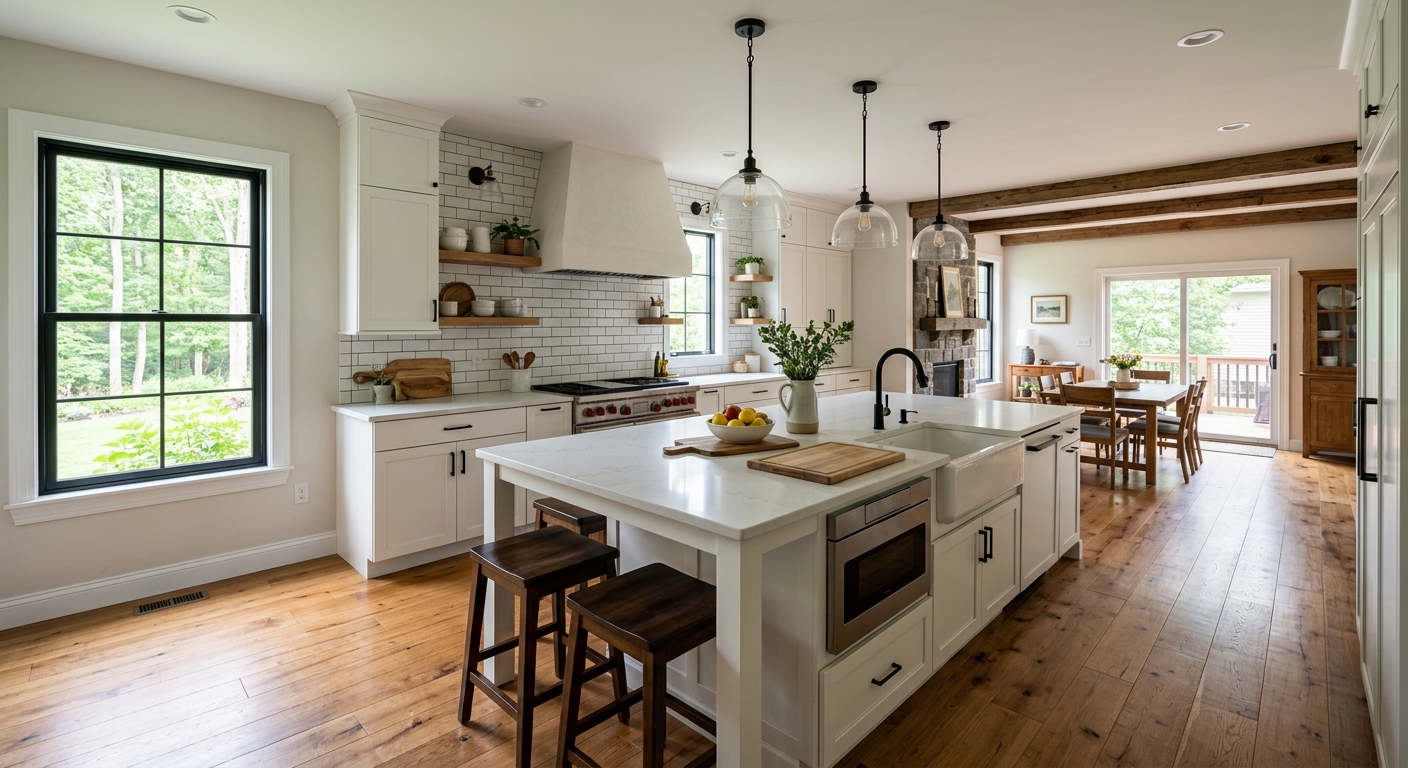
What a kitchen remodel costs in Lackawaxen
Lackawaxen homeowners face a wide range in kitchen renovation costs, heavily shaped by housing age and who lives there. With a homeownership rate of 90.9% and a median household income of $77,348 (U.S. Census Bureau, ACS 2024), most kitchen projects here are owner-occupied and aim to upgrade original finishes, not just patch up for rentals. Pike County’s housing boom in the 1980s–2000s left many homes with builder-grade kitchens now overdue for replacement. Most kitchens in Lackawaxen are not tight galley layouts from the 1950s, so full gut jobs rarely require moving walls—unless the homeowner wants a major transformation. In this area, the most common budget mistake is pricing a simple refresh and then choosing selections or layout changes from the higher-cost end, which blows up costs and timelines fast.
Cupboards and counters take the bulk of the budget, but travel charges and longer lead times—common in Pike County’s rural market between Scranton–Wilkes-Barre and New York–Newark—can nudge costs higher, especially if skilled labor is stretched thin.
| Scope |
What's included |
Duration |
Price range |
| Full gut remodel, same layout |
cabinets, counters, appliances, flooring, lighting, fixtures |
6–10 weeks |
$29,500–$118,500 |
| Gut plus layout change |
all of the above plus moved plumbing, electrical, walls |
10–16 weeks |
$64,500–$118,500 |
| Cabinet replacement (stock to semi-custom) |
remove and install cabinets, hardware, patching |
1–3 weeks |
$6,900–$29,500 |
| Cabinet refacing |
new doors and drawer fronts, veneer, hardware |
3–6 days |
$6,900–$20,000 |
| Countertop replacement only |
template, fabricate, install, reconnect sink |
1–3 weeks |
$4,000–$16,000 |
| Kitchen flooring only |
remove existing, install new flooring |
3–6 days |
$4,900–$20,000 |
Estimates for a typical Lackawaxen kitchen. Cabinet grade and whether the layout changes move these figures more than square footage.
Comparing kitchen renovation bids in Lackawaxen
Sorting through kitchen bids in Lackawaxen starts with understanding allowances. An allowance is a placeholder figure for materials you haven’t picked yet—think tile, appliances, or lighting. Two bids with identical totals can differ by thousands once you choose finishes, simply because one builder assumed $2,500 for countertops and another only allowed $800. Before comparing totals, scrutinize every allowance line. Insist on itemized allowances that match local material costs, not round numbers meant to keep a bid artificially low.
Beyond allowances, review cabinet brand and line, specifying exactly what you’ll receive, not just “quality cabinets.” Countertop quotes should name the actual material, thickness, and how seams will be handled. For electrical, make sure the scope defines how many circuits and covers GFCI requirements. Unforeseen conditions—like water damage found after cabinet removal—should specify how extra work is priced and require written change orders. Never accept a process that advances change orders verbally; written approval protects both parties.
Payments should be tied to milestones—such as demolition, cabinet delivery, and completion—rather than set dates. Modest upfront deposits are typical, but be wary of front-loaded schedules. Clear, written contracts are required by Pennsylvania law for jobs over $500, with a three business-day cancellation right. Insist on lien waivers from subcontractors at each payment to protect yourself.
| Line item |
What to look for |
Red flag if… |
| Allowances |
realistic amounts, itemised |
round numbers with no basis |
| Cabinetry |
brand, line, box construction |
'quality cabinets' |
| Countertops |
material, thickness, edge, seams |
material name only |
| Electrical |
circuits to be added, GFCI scope |
'as needed' |
| Unforeseen conditions |
how they are priced and approved |
not addressed |
| Change orders |
written approval before work |
verbal |
| Payment |
milestone-based, modest deposit |
front-loaded |
| Lien waivers |
from subs at each payment |
not offered |
Where the money actually goes
When you see a kitchen budget for a full remodel in Lackawaxen, cabinetry usually absorbs more of your dollars than anything else, commonly running 25–35% of the total. Labor and installation come next, clocking in at 20–30%, particularly if the floor plan or walls shift. Countertops take 8–15%, depending on whether you choose laminate, engineered stone, or full slab. Appliances—because of the wide range between basic and built-in—can land anywhere from 10–20%. Flooring, lighting, and plumbing typically round out the next tier.
The two most overlooked lines: a contingency reserve for what’s behind the walls (electrical splices, subfloor rot) and hard-to-guess “soft costs” such as design services, permits, deliveries, and disposal fees. These are not afterthoughts—you should plan for them upfront rather than scramble at the end.
If you have an extra $1,000, put it into better cabinet hardware or drawers rather than higher-end appliances if your cabinets are basic—balance counts. Going high-end on appliances and settling for low-end cabinets is a mismatch. For a full mid-range remodel in Lackawaxen, expect the breakdown below to map onto a typical $64,500 job.
| Category |
Share of budget |
Notes |
| Cabinetry |
25–35% |
the largest line and the longest lead time |
| Labour and installation |
20–30% |
rises sharply if the layout changes |
| Countertops |
8–15% |
material choice drives the swing |
| Appliances |
10–20% |
widest range of any category |
| Flooring |
5–10% |
|
| Lighting and electrical |
5–10% |
higher in older homes needing circuits |
| Plumbing and fixtures |
4–8% |
|
| Permits, design, disposal |
3–6% |
usually forgotten in early budgets |
| Contingency |
10–15% |
not optional in a pre-1980 house |
Choosing cabinetry
Cabinet choices drive the entire kitchen budget for Lackawaxen. Homeowners here, most living in 1980s–2000s houses, often want a major visual upgrade—but not every kitchen needs a full gut to get there. Refacing is an honest way to save, where the structure and layout suit you and the boxes are in good shape. It keeps the guts and swaps out all exposed parts. If the layout works and the cabinets are solid plywood, refacing is almost always worth considering and is far cheaper than new cabinets.
Stock cabinets are prebuilt in set widths and heights. These fit well in straight, modern walls, but most homes in Pike County—even from the subdivision era—feature wall runs that call for a filler strip or clever adaptation. Semi-custom offers adjustable sizes and a wider array of finishes, bridging the gap when the stock just does not fit cleanly. Custom is for non-standard dimensions, unique layouts, or specific tastes, and brings the highest price and slowest delivery.
Quality matters regardless of budget. Insist on plywood boxes over particleboard for strength. Dovetail drawers last longer than stapled ones. Frameless cabinets offer more space and a cleaner look, but can cost more. Hardware is worth the upgrade to full-extension, soft-close as it has the most day-to-day impact and does not break the budget.
Most kitchens in Lackawaxen needing updates have standard layouts from the 80s–2000s and finish-level cabinets that often push homeowners to at least a semi-custom choice if they want a seamless fit and upgrades.
| Option |
Cost |
Best when |
Limitation |
| Painting existing cabinets |
$1,200–$3,500 |
boxes and doors sound, tight budget |
no layout or style change |
| Refacing |
$6,900–$20,000 |
boxes square and layout works |
storage unchanged |
| Stock cabinets |
$6,900–$29,500 |
standard dimensions fit |
filler strips, limited finishes |
| Semi-custom |
$20,000–$29,500 |
non-standard walls or finishes |
6–12 week lead time |
| Full custom |
$20,000–$29,500 |
unusual layout or high-end design |
longest lead, highest cost |
Code requirements for Lackawaxen kitchens
Pennsylvania's Uniform Construction Code (UCC), based on the IRC, is the governing authority for kitchen renovations in Pike County. In most Pike County townships, including Lackawaxen Township, work that only involves replacing cabinets—without plumbing or electrical changes—typically does not require a permit. Replacing counters, paint, and hardware also fall outside permit requirements. However, as soon as your renovation changes plumbing or electrical systems—such as moving or adding a sink, or adding new circuits—a permit is necessary. Expect stricter review if you move walls or install a new range hood due to code-mandated mechanical and safety checks.
Code enforcement here is handled by township code offices. If you’re in Dingman Township, understand that permits are triggered by kitchen renovations with utility changes. Inspections follow the township’s process—unpermitted work can create issues when you resell or refinance, easily flagged during a buyer’s due diligence.
For any contract over $500, your contractor must have Home Improvement Contractor registration from the Pennsylvania Office of Attorney General—verify at hic.attorneygeneral.gov. All employers must carry workers’ compensation insurance, verifiable via WCAIS. Avoid any contractor that cannot produce both. Skipping permits, even for quick jobs, is a bad bet as it can stall or derail a sale years later.
Lead times, sequencing and why it takes longer
Most homeowners in Lackawaxen overestimate how fast a kitchen renovation can happen. The process has set sequences that don’t budge, driven mostly by long-lead items: cabinets and countertops. First comes design and measurement, with several rounds if semi-custom or custom cabinets are involved—common given Pike County’s not-quite-standard layouts from late-20th-century builds.
Cabinets must be ordered before demo starts. Why? Delivery timelines are stretching longer—6–12 weeks for semi-custom—and labor shortages in Pike County mean you may wait weeks just to schedule skilled crews. Once demolition starts, rough electrical and plumbing gets installed, then inspected. Only after inspection can cabinets be set. Once cabinets are installed, the countertop company comes to template—never off a drawing, always the real cabinets in place. That triggers an additional 1–3 weeks for fabrication and installation, a dead period few anticipate.
Flooring, backsplash, and final detail work come after counters. Skipping steps or trying to “save time” by scheduling trades in parallel almost always leads to rework. The critical path is always cabinets and counters—nothing else moves the project forward or backward as much.
Pike County’s thin rural contractor market can increase lead times further, especially if you are not flexible on start dates. Order all your long-lead materials—especially cabinets—before any demolition so you’re not waiting in a torn-up kitchen for weeks or months.
General contractor, kitchen firm, or manage it yourself?
How you hire shapes your experience from start to finish. In Lackawaxen and greater Pike County, where labor is tight, a design-build kitchen firm offers the highest price tag but smoothest process. They handle design, product ordering, installation, and scheduling, so you have one point of accountability and no trade handoffs. This is well-suited for complex projects or if you can't spare much time for oversight.
Hiring a general contractor is the “middle path.” You or a designer will specify products, while the GC sequences trades, manages permits, and keeps things moving. Expect mid-range cost and mid-level homeowner involvement—designers usually source cabinets and finishes, while the GC lines up the plumber, electrician, and carpenters.
The cheapest (and riskiest) is to self-manage. Here you’ll hire and schedule each trade, apply for permits, order all products, and resolve issues yourself. It works best in a straightforward remove-and-replace scenario without major code changes. If your project triggers permits, or if you have a full-time job, this is a recipe for stress—especially given Pike County’s lagging labor availability. Scheduling, delivery coordination, and scope change management are not just Google searches; they’re hours of troubleshooting. Most homeowners underestimate how quickly a missed phone call from a plumber can snowball into weeks of delay here.
Frequently asked questions — kitchen renovation in Lackawaxen
Why is there a gap after cabinets are installed?
The gap after cabinets are installed is a built-in part of the kitchen renovation sequence in Lackawaxen—and not something your contractor can speed up. Once cabinets are set, the countertop company must visit to make a physical template. This is because counters, especially stone or quartz, will only fit correctly if measured off the actual cabinet positions. Fabrication then takes another 1–3 weeks before the counters are ready for install. This wait is made longer in Pike County due to thinner fabricator competition and longer delivery routes. For a full kitchen remodel, allow for this week (or more) of downtime—it is unavoidable unless you choose a basic laminate top with on-site cutting, but even then, some delay is normal. This is true whether you’re spending $29,500 for a modest gut or $64,500 for an upgrade: the pause is in the process, not your budget.
Why are kitchen quotes in Lackawaxen so far apart?
Kitchen quotes in Lackawaxen can run thousands of dollars apart for the same reason you’ll find allowance lines that make almost no sense outside this rural Pike County market. Some contractors include only bare-minimum for things like tile or appliances, with token allowances to keep the bid low on paper. Others price local materials more accurately but look more expensive at first glance. On top of that, travel charges and higher labor rates—due to a thinner market between Scranton–Wilkes-Barre and New York–Newark—increase some quotes over others. Compare what is actually included, line by line. Make sure the price covers real materials and true local labor costs—like a cabinet replacement at $6,900–$29,500—not fantasy numbers made to win a job. Read the fine print, especially on allowances, before you choose.
Can I cancel a renovation contract in Pennsylvania?
Yes. Under Pennsylvania’s Home Improvement Consumer Protection Act, you have a three business-day right to cancel any home improvement contract over $500, which applies in Lackawaxen and all of Pike County. The contractor must provide written notice of this right in your contract. If you sign a kitchen remodel agreement on Monday, you have until Thursday at midnight to notify them in writing if you change your mind. The deposit must be returned with no penalty if you cancel within this window. This law was enacted to give homeowners in Pennsylvania a chance to reconsider large commitments—particularly important with complex jobs like full kitchen remodels that can reach $29,500–$118,500. Always read the cancellation terms before signing; reputable contractors will not push back if you choose to use this right.
Does a kitchen renovation increase home value in Lackawaxen?
Renovating your kitchen in Lackawaxen generally increases both livability and market appeal, especially because over 90% of homes here are owner-occupied (U.S. Census Bureau, ACS 2024) and most kitchens trace back to 1980s–2000s subdivision builds. Updated kitchens with new cabinets and surfaces are particularly attractive in Pike County’s resale market. While exact returns vary with scope and quality, a well-executed renovation in the $29,500–$64,500 range typically recoups a solid portion of its cost—especially if layout improvements and refreshed finishes bring dated builder-grade originals up to current standards. However, the biggest payback is often simply an easier, faster sale in a competitive market, not a dollar-for-dollar return. Overspending on ultra-high-end finishes in a modest home can under-deliver, so match upgrades to neighborhood expectations.
Is laminate countertop a bad choice?
Laminate countertops are not a bad choice for many homes in Lackawaxen, especially if you are working within a tighter kitchen budget. Durable, modern laminates have improved in both looks and feel, holding up well against wear and allowing you to refresh your kitchen without a full gut remodel. For a simple countertop replacement, prices land between $4,000–$16,000 depending on scope and material. Laminate also offers the fastest install, with little downtime. The main drawbacks are heat tolerance and lack of resale cachet versus stone. If you plan to stay long-term, or your kitchen already has basic cabinets, laminate brings a lot of bang for the buck. Save your dollars for new cabinet hardware or lighting before stretching to quartz in a home where buyers will not pay a premium for it.
What is an allowance in a renovation quote?
An allowance is essentially a budget placeholder in your renovation quote for items you haven’t yet selected—such as tile, appliances, or lighting fixtures. In Lackawaxen, contractors use allowances to keep a project moving while you finalize your choices. For example, a bid might include a $4,000 appliance allowance. If you pick appliances that ultimately cost $5,200, you pay the $1,200 difference. The issue arises when one quote has a realistic allowance based on Pike County retail prices, and another plugs in a low-ball figure to keep the total cost down. That can make a quote look artificially cheap, only for the final tally to spike. Always examine each allowance line against real-world pricing, and ask for itemized bids—especially on countertop or cabinet lines, which swing from $6,900 to over $29,500 depending on selection.
Are Lackawaxen kitchens typically small galley layouts?
Most kitchens in Lackawaxen are not small galley designs from the mid-20th century. Since Pike County is dominated by subdivision growth from the 1980s to 2000s, layouts are typically more open, with U-shape or L-shape footprints and builder-grade finishes ripe for replacement. Galley kitchens are more common in homes built before 1980, which make up a minority (about one-third) of the local housing stock (U.S. Census Bureau, ACS 2024). Modern kitchens here are more likely to need upgraded surfaces and cabinetry, rather than major wall or layout changes. For this reason, most homeowners opt for finish upgrades or full remodels, starting around $29,500 for a moderate-size, open-plan space.
How much does a kitchen renovation cost in Lackawaxen?
The cost of a kitchen renovation in Lackawaxen depends entirely on scope, finish level, and whether you’re reworking utilities. For a full gut remodel, expect a total in the $29,500–$118,500 range, with typical jobs landing closer to $64,500. Cabinet replacement on its own runs from $6,900–$29,500, while just a countertop swap might be between $4,000–$16,000. These are 2026 market estimates reflective of Pike County’s tighter contractor supply and frequent travel charges, so they trend slightly higher than nearby metros. Remember that updating builder-grade cabinets and finishes in 1980s–2000s homes is the most common project type here, and as soon as you move plumbing or walls, costs and timelines increase sharply.
Is a cosmetic refresh enough or do I need a gut remodel?
Whether you can get by with a cosmetic refresh or need a gut remodel depends on the condition and layout of your current kitchen. Many homes in Lackawaxen from the 1980s–2000s have layouts that still “work,” but finishes—builder-grade cabinets, laminate counters, tired flooring—are dated. In these cases, painting cabinets, replacing doors (refacing), or just doing new countertops and pulls can stretch a modest budget ($4,000–$20,000) surprisingly far. Go for a gut remodel—with new layout, wiring, plumbing—if the existing kitchen has function or code issues (like insufficient outlets or failing cabinets) or if you're planning a major lifestyle change such as opening up to a living area. Always start with an honest assessment of your cabinets and layout; you may not need to spend for a full tear-out if the bones are solid and the flow is good.