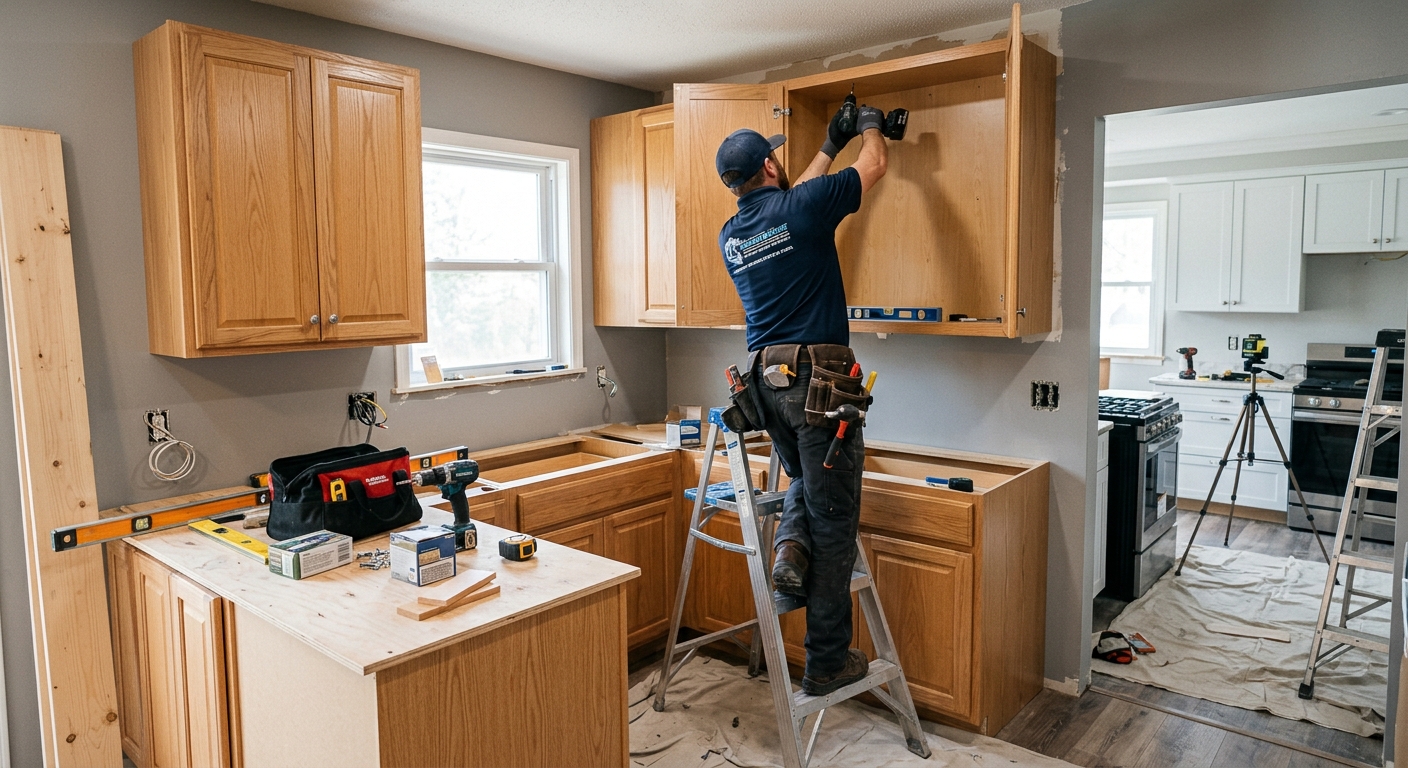
What a kitchen remodel costs in North Lebanon
In North Lebanon, kitchen renovation costs span a wide range, directly tied to the scope of the work and the era of the home. With a median household income of $74,858 and a homeownership rate of 89.3% (U.S. Census Bureau, ACS 2024), most kitchen remodeling projects in North Lebanon are planned by owners with a long-term view—often tackling decades-old layouts in houses built before 1980. That means you'll see everything from inherited 1950s galley kitchens that need walls moved, to more modern spaces from the 1990s that mostly call for updates and new finishes.
Most blown kitchen budgets come from pricing a cosmetic update, then getting talked into layout or utility changes that shift the job into an entirely different price class. Define your project scope early—whether it’s just new cabinets or a total gut and new layout. Here’s what you can expect, using 2026 estimates for North Lebanon kitchens:
| Scope |
What's included |
Duration |
Price range |
| Full gut remodel, same layout |
cabinets, counters, appliances, flooring, lighting, fixtures |
6–10 weeks |
$29,500–$117,500 |
| Gut plus layout change |
all of the above plus moved plumbing, electrical, walls |
10–16 weeks |
$63,500–$117,500 |
| Cabinet replacement (stock to semi-custom) |
remove and install cabinets, hardware, patching |
1–3 weeks |
$6,900–$29,500 |
| Cabinet refacing |
new doors and drawer fronts, veneer, hardware |
3–6 days |
$6,900–$19,500 |
| Countertop replacement only |
template, fabricate, install, reconnect sink |
1–3 weeks |
$3,900–$15,500 |
| Kitchen flooring only |
remove existing, install new flooring |
3–6 days |
$4,900–$19,500 |
Estimates for a typical North Lebanon kitchen. Cabinet grade and whether the layout changes move these figures more than square footage.
Code requirements for North Lebanon kitchens
Typical kitchen upgrades in North Lebanon, such as repainting cabinets, replacing hardware, or installing a new countertop with no changes to plumbing or electrical, do not generally require a permit. Where homeowners get caught is when the project moves beyond cosmetic work—installing new circuits, moving plumbing lines, changing the room layout, or replacing a range hood with a ducted model. In these cases, a permit is often triggered under the Pennsylvania Uniform Construction Code (UCC), and a plan review is commonly required if you’re changing structural or mechanical systems, especially within Lebanon city.
For most structural, electrical, or plumbing changes, your municipality’s code enforcement office will guide you on application and review. One quirk is that in Lebanon County, third-party agencies—not municipal staff—typically handle electrical inspections. This can add lead time and an extra scheduling step that surprises many residents.
Contractors working on your home for over $500 must be registered with the Pennsylvania Office of Attorney General’s Home Improvement Contractor program. You can and should verify a contractor's registration at hic.attorneygeneral.gov. If your contractor employs others, they're also required to maintain workers’ compensation, which is mandatory in Pennsylvania—verify this in WCAIS (wcais.pa.gov) before work begins.
The resale risk: If you skip permits on work that requires them, especially changes to electrical, plumbing, or layout, you may face problems when selling your house. Disclosures, inspections, or title work can bring out unpermitted work years later, leading to costly retroactive corrections. The cleanest approach is always to permit as required up front.
What moving the sink really costs
The biggest jump in kitchen renovation cost in North Lebanon comes when you move core services like the sink, range, or walls. Keeping plumbing and electrical in place keeps you in the more accessible price band—once you start moving them, your project requires extra trade coordination, engineering, and almost always a building permit, shifting you up to a much higher tier.
Here’s why: Moving a sink isn’t just running new pipes. Drain lines need a constant slope, and in mid-20th-century Lebanon County homes, you’re likely dealing with a basement, slab, or even a finished ceiling below—each complication can add days of labor and may require opening up flooring or ceilings elsewhere. Moving electrical for a range means confirming your panel has capacity for a new circuit—if not, a panel upgrade alone can run thousands. Removing a wall introduces another layer: you need to determine if it’s load-bearing, and if it is, you’ll need an engineer's review and stamped drawings. Venting a relocated range may mean coring through brick or siding for an exterior vent.
Permits are almost always triggered by these kinds of changes under Lebanon city enforcement, especially anything structural or mechanical. The price move is steep: for example, the jump from a full gut remodel with the same layout ($29,500–$117,500) to a gut plus layout change ($63,500–$117,500) reflects the real-world costs of service relocation, engineering, and additional code requirements.
In short: before deciding to move the sink, seriously consider if the current layout makes the kitchen unworkable, or if it’s simply outdated. Moving a fixture a few feet for aesthetics alone is rarely worth doubling your project cost.
Does a kitchen renovation pay back in North Lebanon?
A renovated kitchen nearly always makes a North Lebanon home easier to sell, but it’s rare for the project to pay back more than you put into it—especially if you upgrade far beyond the area’s typical home. In this market, where the median household income is $74,858 and the housing stock is predominately mid-century, spending much more than your neighbors is unlikely to be recouped at resale time.
For resale value, mid-range renovations—new surfaces, modern lighting, cabinet replacement without moving walls—usually recover a higher share of their cost than fully custom or high-end builds. If you’re renovating to sell, neutral finishes and functional upgrades are safest. Layout changes or luxury appliances rarely increase your selling price as much as they add to your costs.
If you’re planning to stay for years and the layout drives you batty, invest in what makes your own daily life better—and let resale take a back seat. But if selling within five years, tie your kitchen budget to what’s common in North Lebanon. Over-improving, like putting a full custom kitchen into a modest 1960s ranch, returns cents on the dollar no matter how nice it looks.
Short version: Renovate for your life, not just for the next owner, but keep neighborhood reality in sight if you expect a payback.
Planning appliances before cabinets
One of the most expensive sequencing mistakes in North Lebanon kitchen work is selecting cabinets before finalizing appliance choices. Cabinets are fabricated to fit actual appliance models, not rough dimensions, and a refrigerator or range bought after cabinets are ordered may simply not fit—especially in older homes with tighter spaces.
Plan refrigerator type first. Standard-depth fridges stick out 4–6 inches past cabinets; counter-depth models cost more, but will sit flush and look built-in. Slide-in ranges need a precise cabinet opening on both sides, while freestanding ranges are more forgiving but less seamless. If you switch from electric or gas to induction, the electrical panel must be checked—modern induction ranges often require a dedicated 240V circuit, which wasn’t planned for in mid-century Lebanon County kitchens.
Dishwashers offer “panel ready” options, but those require a matching cabinet front—this must be ordered at the same time as the cabinets. For range hoods, ducted to the outside is always preferred for air quality, but in some homes it’s tough to route, so recirculating models get used as a compromise. Just know recirculating won’t remove moisture or odors as well.
Finally, if you’re considering pro-style appliances, realize that much of the added cost is visual and tactile—the actual cooking results aren’t night-and-day for most home cooks. Also, supply chains mean that some appliances are now special-order with longer lead times than cabinets, so locking these down first matters more than ever.
Four kinds of kitchen project, four budgets
When you hear “kitchen remodel,” that covers at least four distinct project scopes in North Lebanon—and getting clear which you’re doing will save you massive headaches and money.
- Cosmetic refresh: This means paint, new hardware, light fixtures or maybe a backsplash—absolutely no cabinet or layout changes. It brightens up a tired kitchen for the lowest cost and usually doesn’t require a permit.
- Pull and replace: Entirely new cabinets and counters, but everything goes back in the same spots. All plumbing and electrical stay put, so you avoid engineering, permits, and the biggest trade costs. This falls in the $6,900–$29,500 band locally.
- Gut, same layout: Stripped to studs, new insulation, wiring, plumbing, flooring, and surfaces—modernizes everything, but services remain where they are. Costs more due to the depth of the work.
- Layout change: Moving plumbing (sink, dishwasher), electrical (range, circuits), or walls puts you in the full remodel class. Permits, engineering, and specialty contractors become mandatory, and your budget heads into the upper range $63,500–$117,500.
The biggest cost jump is from gut, same layout to layout change. Moving a sink or tearing out a wall means you need an engineer, municipal permits, and more trades involved. It can nearly double the project. Decide which type describes your project before calling contractors—they’ll ask, and honest numbers only come after you know your scope. No one can give you a meaningful price without these decisions made.
Living through a kitchen renovation
Few homeowners in North Lebanon realize just how disruptive a kitchen remodel can be until they’re living knee-deep in it. Plan now for how you’ll cook and eat for anywhere from a week (for new floors) to two months (for a full gut).
Set up a temporary kitchen space: Find a spot for your fridge, set up a folding table or two for a microwave and coffee maker, and keep essentials within reach. Washing dishes will likely mean using a laundry or bathroom sink, and it’s best to stock up on paper plates and utensils. Food costs will go up, as eating out and takeout often fill the gap—over an eight-week gut remodel, this added expense can easily exceed the cost of new flooring ($4,900–$19,500).
Expect dust. Even with plastic sheeting or zip walls, fine dust gets everywhere. If you have pets, plan for doors being open for deliveries and debris removal, and decide whether they need to be boarded or confined. Dumpster placement and staging for materials may take up a driveway or part of the yard—ask your contractor about the plan. If your project involves wall removal, demolition week can be especially noisy and messy; some families choose to move out for that period.
Bottom line: Living through a kitchen remodel takes flexibility, patience, and a realistic expectation for higher food and cleaning bills. Planning for disruption up front is less stressful than being caught by surprise.
Frequently asked questions — kitchen renovation in North Lebanon
Is a cosmetic refresh enough or do I need a gut remodel?
For many North Lebanon homes, especially those built after 1980, a cosmetic refresh—new paint, updated hardware, lighting upgrades, and maybe a backsplash—can provide a big visual boost without the expense or disruption of a gut remodel. The difference comes down to function and condition. If your cabinets are structurally sound, the layout doesn’t frustrate you daily, and there’s no chronic plumbing or electrical issue, a cosmetic update can keep you well within the $6,900–$19,500 range for a dramatically improved feel. Gut remodels make sense for kitchens with failing cabinets, outdated wiring or plumbing, or layouts from a bygone era (which is common in mid-20th-century Lebanon County houses). If you aren’t sure, start with what bothers you most and get bids for both approaches—you might be surprised how far cosmetic changes go in these homes.
Does replacing cabinets require a permit?
In most North Lebanon homes, simply replacing kitchen cabinets—without moving plumbing, electrical, or making structural changes—does not require a building permit. This is true in most Lebanon County municipalities, where you can do “pull and replace” work without triggering a code review, as long as the kitchen’s footprint and utilities remain exactly where they are. That said, once you plan to relocate a sink, move outlets, open walls, or change the layout at all, you cross into territory where a permit is typically required by the enforcing municipality under the Pennsylvania Uniform Construction Code. When in doubt, check with your local code enforcement office before starting, as unpermitted work can haunt you at resale or cause problems during appraisals or refinances. For pure cabinet swaps, expect a budget of $6,900–$29,500.
Should I order cabinets before demolition?
No—you should finalize and order your cabinets before demolition, but always wait for the exact measurements to be confirmed after demolition and rough trades have done their work. In North Lebanon, supply chains and lead times for cabinetry are typically 6–10 weeks, sometimes more for semi-custom or specialty orders. This means planning ahead is vital, but experienced contractors will want to double-check final dimensions after any framing or wall work is done. Ordering too early risks expensive remakes if your walls or floors aren’t plumb, which is common in older mid-century Lebanon County homes. For a typical cabinet replacement project, budget $6,900–$29,500 and plan carefully to avoid delays and mis-measures.
How does North Lebanon's housing stock affect cabinet fit?
Most houses in North Lebanon were built well before 1980, and many feature original walls and floors that have shifted, settled, or bowed over decades. This means standard cabinets often need trim adjustments or modifications to fit the actual, not theoretical, spaces in these homes. Don’t expect drywall and floors to be perfectly square—especially in the many mid-century ranches and split-levels. Good installers expect to “scribe” and shim to match originals. If you’re replacing cabinets, factor in extra time for installation and patching, which is why a professional-grade job will sit at the middle to upper end of the $6,900–$29,500 band. Semi-custom cabinets allow some flexibility for odd-sized walls, but never skip the site measure in older homes around Lebanon County.
What is the difference between stock and semi-custom cabinets?
In North Lebanon, “stock” cabinets come in fixed sizes, finishes, and configurations. They’re mass-produced and tend to be the most affordable, with fewer color and style options and little ability to modify sizes. “Semi-custom” cabinets, on the other hand, add a lot more flexibility—they’re made to order, let you tweak sizes to fit wonky walls, choose from more finishes, and modify configurations. Many Lebanon County homes benefit from semi-custom lines because of the mid-century quirks in room sizes and wall straightness. Expect to pay about 20–30% more for semi-custom, with typical full replacements falling into the $6,900–$29,500 price range in this area. For unique layouts or making the most of small spaces, semi-custom is often worth the jump.
What does a full gut kitchen remodel cost in North Lebanon?
A full gut renovation in North Lebanon—including tearing everything to the studs, replacing floors, insulation, wiring, plumbing, cabinets, counters, fixtures, and appliances—usually starts at $29,500 and can reach up to $117,500 depending on finishes and scope. Most families land around the $63,500 mark for a complete remake, especially in homes that haven’t had a kitchen update in decades (which is common for this area’s aging housing stock). If the layout stays the same, you keep costs manageable, but moving plumbing, adding structural work, or choosing premium appliances can push you into the higher end. Always clarify scope early—it’s the single factor that most changes the budget.
Can I over-improve for my North Lebanon neighbourhood?
Absolutely—and it happens more than most homeowners expect. With a median household income of $74,858 in North Lebanon, there’s a “ceiling” to what buyers expect, even in nicely updated homes. Putting in a kitchen that costs much more than what’s typical in your neighborhood often means you won’t recoup that investment when you sell, regardless of the quality. If most homes nearby have kitchens in the $29,500–$63,500 range, you likely won’t see that extra return from a $117,500 luxury remodel. Focus on functional, quality upgrades that align with surrounding homes, unless you plan to stay for a decade or more and get the daily value from the investment yourself.
What is an allowance in a renovation quote?
An allowance in a North Lebanon kitchen renovation quote is a budget number set aside for items you haven’t picked yet—cabinets, tile, appliances, or fixtures. For example, your contract might include an allowance of $8,800 for countertops, letting you choose actual materials and brands later. If your choice exceeds the allowance, you pay the difference; if it comes in lower, you get a credit. This protects both you and the contractor from cost overruns due to scope creep, and gives you flexibility to select finishes at your own pace. Always ask how each allowance was calculated and what is covered—surprises in allowances are a common cause of budget shocks late in the project.
How much more does moving the sink and range cost?
Moving the sink and range—especially in a mid-century North Lebanon home—means a significant jump in cost. Relocating plumbing and electrical changes the project from “gut, same layout” at $29,500–$117,500 into a “gut plus layout change,” starting at $63,500 and topping out at $117,500. This steep increase is due to factors like running new drain lines with proper slope, rerouting electrical, possibly upgrading the panel, and opening up additional walls or floors. It also triggers permit and inspection requirements and may require stamped engineering drawings if a wall moves. Unless your layout is truly dysfunctional, it’s usually more cost-effective to keep these key services where they are.