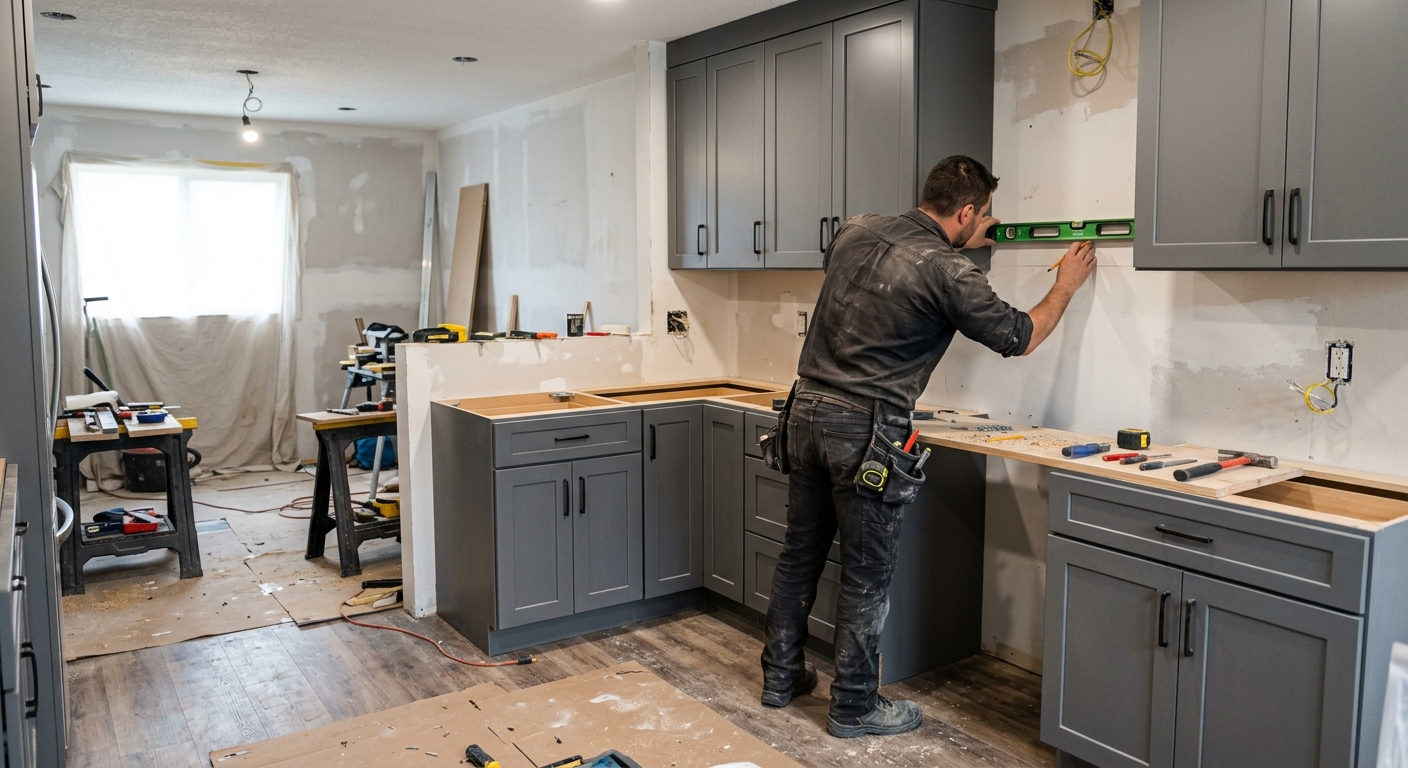
Kitchen renovation costs in Richland — 2026
Renovating a kitchen in Richland means matching your investment to how you use the house, its age, and your long-term plans. With a homeownership rate near 70% and a median household income of $66,557 (U.S. Census Bureau, ACS 2024), most local kitchen remodels are by owners looking to modernize a space they plan to use, not landlords flipping a unit. Older homes are common across the Johnstown–Ebensburg–Richland area, where much of the housing stock dates to 1900–1940. That era tends to mean galley kitchens and tight layouts, and it’s routine to need layout changes, not just a swap of finishes.
The most common way budgets get blown is by comparing bids for “cabinet replacement” and then approving work that quietly adds plumbing, electrical, and wall changes. Be clear about what you want: keeping everything in place is a different ballpark from a full-gut and reconfiguration, and so is the price. Here’s what to expect for 2026:
| Scope | What's included | Duration | Price range |
| Full gut remodel, same layout |
cabinets, counters, appliances, flooring, lighting, fixtures |
6–10 weeks |
$28,500–$114,000 |
| Gut plus layout change |
all of the above plus moved plumbing, electrical, walls |
10–16 weeks |
$62,000–$114,000 |
| Cabinet replacement (stock to semi-custom) |
remove and install cabinets, hardware, patching |
1–3 weeks |
$6,700–$28,500 |
| Cabinet refacing |
new doors and drawer fronts, veneer, hardware |
3–6 days |
$6,700–$19,000 |
| Countertop replacement only |
template, fabricate, install, reconnect sink |
1–3 weeks |
$3,800–$15,000 |
| Kitchen flooring only |
remove existing, install new flooring |
3–6 days |
$4,800–$19,000 |
Estimates for a typical Richland kitchen. Cabinet grade and whether the layout changes move these figures more than square footage.
Choosing a countertop for a Richland kitchen
Daily life in a Richland kitchen usually means a mix of cooking, cleaning, and everything in between. Countertop choice should hinge on how it will hold up to wear, spills, and user maintenance—not just what’s trending this year. Quartz is engineered and non-porous, making it low maintenance and stain-resistant, but a hot pan will scorch it, and repairs are rarely invisible. Granite is harder and more heat-tolerant, but being natural stone it needs periodic sealing and is susceptible to staining if neglectful. Laminate, which is often dismissed, has improved dramatically and resists stains well; edge swelling from standing water remains its one real tradeoff but for rentals or modest kitchens, it’s practical and cost-effective, not a cut corner.
Butcher block offers a warm look and soft landing for dropped objects but needs regular oiling, is vulnerable to stains and nicks, and shows water damage—however, gouges can be sanded down. Solid surface materials (like Corian) are fully repairable, can have seams nearly disappear, and resist most stains, though they can scratch and aren't always heatproof.
The price moves up or down with fabrication details. Expect a template visit for precise fit; this is more accurate than working from dimensions and is standard for anything except the simplest laminate jobs. Edge profiles (from square to elaborate), sink and cooktop cutouts, and the number/location of seams add labor and cost. Some shops will charge for a complex edge or a sink with a tight radius. If your budget caps at $3,800–$15,000 and your kitchen sees hard use, there is no shame in choosing a well-made laminate or basic solid surface. Spend for looks or status if you wish, but not because you must.
What moving the sink really costs
Changing a kitchen layout in Richland—especially moving the sink or range—kicks the project onto a different cost tier. Keeping plumbing, wiring, and major appliances in place almost always controls costs; as soon as a sink moves, expenses spike. The problem isn’t the distance—moving a drain two feet or ten still means rerouting piping with enough downward slope, which is often the sticking point if you’re on a slab or finished basement ceiling. If the new sink position is an island in a 1930s house, just getting the waste line there can require creative (read: expensive) work.
Running new circuits introduces another variable. Old panels in Johnstown-era homes sometimes have no spare breakers, so a new subpanel can be required even for a short move. Any wall you’re removing may be load-bearing, which will require an engineer’s input, plan review in adjacent areas, and a permit—none of which are little add-ons. Venting a relocated range hood demands an exterior wall opening, which could expose surprises in older wall framing.
In Richland Township, cosmetic work and cabinet swaps rarely require a permit. But as soon as plumbing or electrical changes are made (especially moving them), that typically triggers permit requirements in neighboring municipalities. The extra cost for moving plumbing and electrical—versus simply replacing finishes—can be anywhere from $20,000–$50,000 on top of the base $28,500–$114,000 gut remodel figure, depending on scope. My best counsel: unless the current layout makes daily life truly miserable, think twice before moving the sink. Most of the time, the money makes more impact in better cabinets, counters, or lighting.
Why the electrical line grew
The most common source of kitchen budget shock in older Richland-area homes is what’s behind the walls—specifically, old wiring. Modern code requires dedicated 20-amp circuits for countertop appliances, GFCI protection at outlets near any sink, receptacles spaced so no point on the counter is more than two feet from one, and dedicated circuits for the dishwasher, disposer, microwave, and, for all-electric setups, a 240-volt line for the range. Even kitchens from the late 1990s usually don’t have enough circuits for all these devices.
In Cambria County, especially in Johnstown and Westmont where most homes were built between 1900 and 1940, two-wire ungrounded circuits and a panel that runs the whole kitchen (and maybe half the downstairs lights) on one fuse is more common than you'd think (U.S. Census Bureau, ACS 2024). Aluminum wiring sometimes appears in pre-1980 houses as well. Once your contractor opens the walls, no electrical inspector—commonly a third-party like Middle Department Inspection Agency—will pass the job unless all new work meets current requirements. This part isn’t negotiable, and if not accounted for, it regularly doubles the electrical allowance mid-project.
Budget $4,000–$14,000 to bring kitchen electrical up to current code, depending on service upgrades needed and existing condition. It’s a chunk of change, but it’s fundamental to safety and resale.
Defining your scope before you get quotes
If you want a realistic number from a contractor in Richland, you first need to define your project’s scope. “Kitchen remodel” can mean everything from a new backsplash to a total gut and room reconfiguration, a fivefold price difference. Here’s how most scope tiers break down—and where the steep cost jumps occur:
- Cosmetic refresh: New paint, hardware, upgraded lighting, and maybe a backsplash. No cabinet or layout changes. Cheapest and fastest, but leaves layout and function untouched.
- Pull and replace: Replace cabinets, countertops, sink, faucet; everything stays where it is. No plumbing, electrical, or wall changes. The sweet spot for most owner-occupied homes on a budget.
- Gut, same layout: Stripped to the studs, all services (electrical, plumbing) are brought up to code but left in the original positions. Modern look and performance, but no layout shift.
- Layout change: Walls removed or moved, major appliances shifted, new plumbing and circuit runs, possibly structural work. This is the cost cliff—it triggers plan review, permits, engineering, and draws more specialized contractors.
If you don’t know your tier, expect any “quote” to be a wild guess. The jump from gut-same-layout ($28,500–$114,000) to layout-change (starting at $62,000 and up) is not something most homeowners are prepared for. Define your project tier before you call anyone out. It will save you time (and keep you from chasing misleading numbers).
Allowances, exclusions and change orders
The reason kitchen bids in Richland are so hard to compare isn’t just price—it’s what’s included. The hidden driver is the “allowance,” which fills in for any material not yet chosen: tile, fixtures, even appliances. One contractor may use an adequate figure for a backsplash; another may insert a round number that won’t buy what you actually want. Two proposals at the same bottom line might differ by thousands in real-world cost because of thin allowances.
Compare allowance lines—by item, not just total. Demand a cabinet brand and line, and do the same for countertop material, thickness, and edge. Make sure the bid outlines how unknowns (bad wiring, hidden leaks) will be handled, and that any change order (extra work) requires your written sign-off. Payments should follow milestones like demo or cabinet set, not calendar days. For each payment, lien waivers from subcontractors protect you if someone isn’t paid down the hire chain.
Pennsylvania’s Home Improvement Consumer Protection Act says you must have a written contract for anything over $500, and you always have three business days to cancel. Never skip the paperwork.
| Line item | What to look for | Red flag if… |
| Allowances |
realistic amounts, itemised |
round numbers with no basis |
| Cabinetry |
brand, line, box construction |
'quality cabinets' |
| Countertops |
material, thickness, edge, seams |
material name only |
| Electrical |
circuits to be added, GFCI scope |
'as needed' |
| Unforeseen conditions |
how they are priced and approved |
not addressed |
| Change orders |
written approval before work |
verbal |
| Payment |
milestone-based, modest deposit |
front-loaded |
| Lien waivers |
from subs at each payment |
not offered |
Permits and inspections for a Richland kitchen
In Richland Township, most cosmetic kitchen work—paint, hardware swaps, even refacing or plain countertop replacements—does not typically require a permit. Full cabinet replacement, as long as no new walls, plumbing, or electrical circuits are added, is routinely completed without a permit in this area. However, projects involving relocated plumbing, new or moved electrical circuits, or taking out walls can trigger permitting needs, especially in neighboring Johnstown, where structural changes and substantial remodels carry permit and plan review requirements.
When permits are triggered, electrical inspections in Cambria County are frequently handled by third-party agencies such as Middle Department Inspection Agency—not the township code department itself—which often surprises homeowners at sign-off. These inspections ensure all new work meets state-adopted code, and inspectors do check for permits at final. Skipping permits can cause major headaches at resale if changes are flagged in a disclosure or by a buyer’s agent.
Pennsylvania requires contractors to have Home Improvement Contractor (HIC) registration for jobs over $500, which is publicly verifiable. Contractors must also carry workers’ compensation insurance—check via the WCAIS system before you sign anything. If the paperwork feels excessive, remember: a clean permit trail protects your property value and makes selling your Richland home much less stressful down the road.
Frequently asked questions — kitchen renovation in Richland
Should I reface or replace my kitchen cabinets?
Refacing is a strong option if your existing cabinet boxes are solid and your kitchen layout works for you—typical for many Richland homes with sturdy, old plywood boxes or recent builds with good frames. Refacing changes only doors, drawer fronts, veneers, and hardware, so it gives a dramatic look for less money and time than full replacement (expect $6,700–$19,000). Replacement makes sense if boxes are damaged, storage needs changing, or you're itching for a different configuration (say, adding a pantry or taller wall units). In code terms, neither usually needs a permit unless coupled with electrical or plumbing moves. For many homeowners in Pennsylvania, especially with the high rate of pre-1980 homes here, refacing lets you avoid touching finishes that can contain lead. Don’t spend on new cabinets just for looks if the bones are good—save the capital for layout or countertop improvements instead.
What is an allowance in a renovation quote?
An allowance in a Richland kitchen renovation quote is a budget placeholder for an item you haven’t picked yet—like backsplash tile, lighting, or appliances. Say your contract references a “backsplash tile allowance” of $750; if the actual tile you choose is $1,400, you’ll pay the extra $650. This is where quotes can be deceptive: one contractor may list realistic allowance amounts, another will lowball them to make their total look better, with surprises hitting later. Especially in Pennsylvania, where written contracts are required for jobs over $500, read every allowance line and get changes in writing. This is crucial since, in the Johnstown–Richland market, material availability shifts and thin allowances are how kitchen projects go over budget. Compare allowance lines before ever comparing total price.
Should I renovate before selling or let the buyer do it?
In Richland and across Pennsylvania, it's almost never worth doing a full kitchen gut ($28,500–$114,000) simply to sell, unless the existing one is truly unlivable or unsafe. Basic cosmetic updates—paint, cabinet hardware, maybe resurfaced counters ($3,800–$15,000)—can freshen a listing without sinking cost you won’t recoup. Most buyers here want layout or material choices tailored to their own needs and tastes, and they can’t “unspend” a big renovation in the price you expect. If your kitchen is clean, well-lit, and functional but dated, let the next owner put in their dream. Focus on repairs, safety, and a blank-canvas appeal.
How does Richland's housing stock affect cabinet fit?
A large share of Richland houses were built before 1980 (U.S. Census Bureau, ACS 2024), and Johnstown and Westmont homes especially skew pre-1940. That often means non-standard wall lengths, out-of-square corners, and finished soffits above cabinets. Ordering stock cabinets can leave unsightly gaps or require lots of filler strips. For older kitchens, it’s wise to budget for at least some semi-custom elements or professional trim work. For newer homes, cabinet replacement is usually more straightforward (and can stay at the lower end of the $6,700–$28,500 cabinet range). Always verify measurements in the demo phase before ordering cabinets, since surprises lurk behind drywall in older Pennsylvania houses.
How much more does moving the sink and range cost?
Shifting the sink or range is where kitchen budgets in Richland routinely balloon. The act of moving plumbing and wiring, even a few feet, moves the project up a tier: you’re looking at total gut-remodel costs with layout changes, starting at $62,000, versus keeping everything where it is (from $28,500). The cost doesn't scale with distance: new drain runs need slope, electrical lines may need panel upgrades, and moving a vent for a range can involve structural and exterior wall work. Also, as soon as these changes are on the table, permits and possible plan review are triggered—which isn’t the case if everything stays put. Unless the current flow is genuinely terrible, spend your money on finishes or storage instead.
Who inspects kitchen electrical work in Richland?
In Richland Township and across much of Cambria County, kitchen electrical work is typically inspected by a third-party agency such as Middle Department Inspection Agency, rather than in-house municipal inspectors. This tends to surprise Richland homeowners, especially those used to big-city procedures. These agencies are thorough—when new circuits or major rewiring is involved, all work must meet the latest Pennsylvania Uniform Construction Code requirements. If your project involves layout or service changes, electrical sign-off will be required at rough-in and final, and inspectors will want to see a permit for relocated or new circuits. Don’t skip this step—it’s practically impossible to sell a home in Pennsylvania with uninspected, unpermitted electrical work on the books.
How much does a kitchen renovation cost in Richland?
In Richland, the typical full-gut, same-layout kitchen renovation lands between $28,500–$114,000, with most projects settling in the middle, depending on finishes and whether the layout stays the same. Cabinet-only projects run from $6,700–$28,500. Richland kitchens are often older and less standardized—more patching and custom trim means costs rarely drop to big-box minimums. If you move plumbing, add circuits, or shift walls, expect total costs to start at $62,000 and go up. Most owner-occupied homes here (about 70%) see kitchen upgrades that balance function and finish—not high-end luxury, but a durable, modernized space with some Pennsylvanian character.
Is laminate countertop a bad choice?
In Richland kitchens, laminate isn’t a compromise—it’s often the right answer. Modern laminate resists stains and cleans easily, and at $3,800–$8,600 for replacement, it keeps budgets in check. Yes, it can scratch and isn’t heatproof, but if the install is careful about edge treatments and seams, it’ll last. In a modest home, rental, or busy family kitchen, spending extra for stone or quartz doesn’t always return value at resale. Many local homes have original laminate still doing its job near a century later, especially in those sturdy midcentury bungalows you find around Richland. Reserve stone or solid surface for kitchens getting very heavy daily use or aiming for a high-end look.
How far ahead should I book a contractor in Richland?
Scheduling in Richland and Cambria County is slower than most of Pennsylvania, since the finish-trade labor pool is thin and travel from the Altoona metro area can tack on weeks. For a full kitchen gut or layout change ($28,500–$114,000), plan to book three to six months out, especially for spring and summer jobs when demand peaks and county inspectors are busier. For modest cabinet or countertop swaps, you may get on a schedule within six to eight weeks—provided your contractor isn’t tied up in Johnstown or Ebensburg. The best local trades fill their calendars with word of mouth; rushing rarely lands a better price or finish. If you want work completed before holidays or a home sale, pad your timeline accordingly.