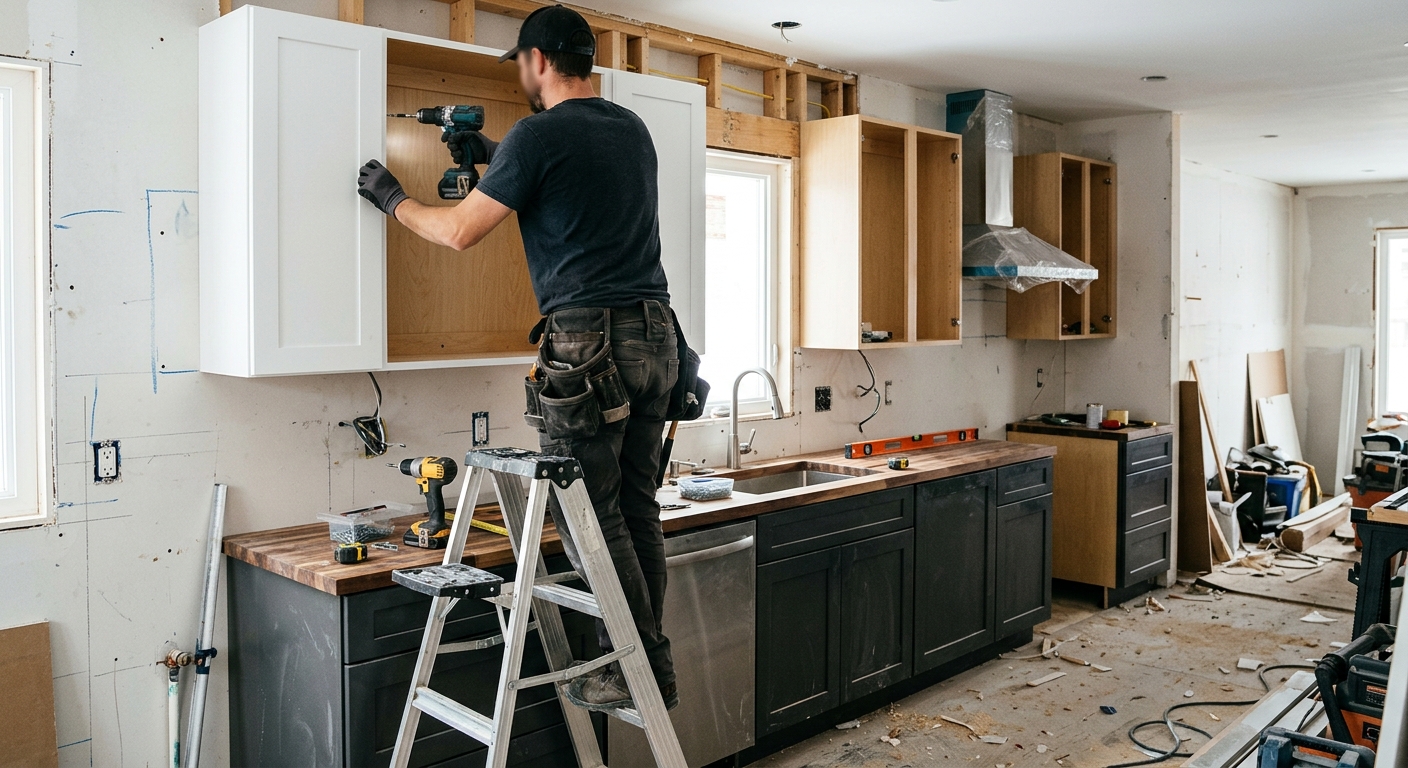
Canton kitchen renovation prices by scope — 2026
Canton’s high homeownership rate—86.7%—means most kitchen remodels are for families looking to improve their own homes rather than quick rental upgrades. With a median household income of $70,349, most Canton homeowners set their kitchen budgets to fit both the reality of house values and how long they plan to stay put. The majority of existing kitchens date from Washington County’s 1950–1980 construction boom; it’s common to find a cramped galley or outdated peninsula arrangement that falls short of current needs, so decisions often come down to whether to move walls or keep the bones in place.
The biggest way Canton budgets go off-track is by estimating for one scope—say, just cabinets and counters—and then replacing appliances, moving plumbing, or redoing floors too. Layout changes are the price-raiser: adding, moving, or removing walls or relocating fixtures triggers both design work and a chain of code upgrades. Before planning, read through what really shapes cost and timing below.
| Scope |
What's included |
Duration |
Price range |
| Full gut remodel, same layout |
cabinets, counters, appliances, flooring, lighting, fixtures |
6–10 weeks |
$29,000–$116,000 |
| Gut plus layout change |
all of the above plus moved plumbing, electrical, walls |
10–16 weeks |
$62,500–$116,000 |
| Cabinet replacement (stock to semi-custom) |
remove and install cabinets, hardware, patching |
1–3 weeks |
$6,800–$29,000 |
| Cabinet refacing |
new doors and drawer fronts, veneer, hardware |
3–6 days |
$6,800–$19,500 |
| Countertop replacement only |
template, fabricate, install, reconnect sink |
1–3 weeks |
$3,900–$15,500 |
| Kitchen flooring only |
remove existing, install new flooring |
3–6 days |
$4,800–$19,500 |
Estimates for a typical Canton kitchen. Cabinet grade and whether the layout changes move these figures more than square footage.
Living through a kitchen renovation
No part of a kitchen renovation in Canton is felt more than losing the space for weeks at a time. Expect at minimum a week or two of demolition and bare subfloor, and commonly up to eight or twelve weeks of a kitchen that is completely off limits. Plan to set up a temporary kitchen — most people move the fridge to the dining or living room, put a microwave and coffee maker on a folding table, and use either a bathroom or the laundry sink for dishes. If your laundry is tucked away in the basement, fill up on paper plates and disposable cutlery early; even “simple” meals become logistics.
Dust is a given, and without plastic sheeting, zip walls, and diligent daily cleanup, the rest of your first floor will start to resemble a jobsite. Ask your contractor where the dumpster and supplies will go, especially if you have limited driveway access or tight property lines. With doorways open much of the day, pets become escape risks and the cold gets in quickly during Washington County’s winter.
Eating out for weeks isn’t just an annoyance—it’s a real budget item. For a family of four in Canton, the extra cost of takeout or restaurant meals during an eight-week project can easily surpass even the cost of new kitchen flooring. For some, moving out during the demolition phase makes sense, but for most projects, staying put with dust control and some daily inconvenience is manageable.
Electrical work in an older Canton kitchen
The most common mid-renovation shock in Canton kitchens—especially ones from the pre-1980 wave—is bringing electrical up to current code. Modern code expects two or more dedicated 20-amp small-appliance circuits, GFCI outlets serving every counter section, dedicated circuits for a dishwasher, garbage disposal, and microwave, plus either 120V or 240V wiring for an electric range. Outlets are required every four feet along the countertop and at each peninsula or island.
In reality, if your home dates from Washington County’s 1950–1980 tract era, you’ll often find a couple of two-wire, ungrounded circuits piggybacked across the kitchen, sometimes with a panel at capacity and aluminum branch wiring showing up in 1960s–70s construction. Once the walls are open, inspectors will require everything be brought up to today’s standards—this isn’t optional. Even in post-1980 kitchens, it’s not rare to find just one circuit serving both lights and outlets, which flunks current code.
Upgrading wiring, adding new circuits to the panel, installing GFCIs and fixing grounding can swing from a minor patch to a full-day’s work with panel upgrades. In Canton, the cost to bring an older kitchen’s electrical up to code typically adds $3,900–$15,500 to a full remodel, with the upper end covering panel replacement or complicated runs.
Resale value and kitchen spending
Renovating your Canton kitchen will almost always help your house sell, but expecting to fully recover a high-end spend is wishful thinking. Mid-range kitchen renovations generally recover a larger percentage of their cost at resale than luxury projects—helping a house stand out without pricing it out of the neighborhood. What matters most locally: projects should fit both the age and value band of the house. With a median household income of $70,349 (U.S. Census Bureau, ACS 2024), over-improving a kitchen—say, gutting and rebuilding with the market’s most expensive finishes—doesn’t track with most resale numbers in Canton.
If you’re renovating to sell, stick to neutral cabinets and counters, upgrade for function, and skip moving the layout for style unless the kitchen is seriously dysfunctional. A well-executed cabinet and counter swap (spend in the $19,500–$29,000 range) will attract buyers and is less likely to become a resale loss-leader than a $100,000+ total overhaul.
If you’re renovating to live in, focus on the features and layout that matter daily—what makes your kitchen actually work for you counts for more than what future buyers think. Just don’t expect the neighborhood to pay you back for custom chef appliances or imported stone when it comes time to sell. It’s always worth asking for honest comps from a real estate agent before you approve a high-end budget.
What's behind the walls in a Canton kitchen
With more than 76% of Canton’s homes built before 1980 (U.S. Census Bureau, ACS 2024), kitchen remodeling here means opening up mid-century suburban walls and dealing with the realities of aging construction. Once demolition starts, common discoveries include out-of-plumb 2x4 framing that complicates installing new cabinets, and floors that slope more than you realized—fixing these can mean a day’s labor or subfloor leveling, typically adding $1,000–$4,000.
Undersized or ungrounded wiring is frequently found; correcting this, particularly to support modern appliance loads, ranges in the $3,900–$15,500 band as a standalone electrical update. Plumbing surprises include galvanized supply lines (prone to corrosion) and cast-iron drains—replacing either can add several thousand dollars. Exterior walls from this era often have minimal insulation or none at all, so expect to install modern batts, adding both comfort and cost.
Previous “DIY” remodels show up as spliced wires in junction boxes or unpermitted laundry drains, and fixing these for inspection can run from minor patching to full rework. If your Canton home is pre-1978, the federal EPA lead paint rule applies—disturbance requires either testing or special containment. Asbestos tile may turn up under old vinyl if the kitchen is original 1950s or ‘60s. Only certified contractors can disturb or remove these, which can send costs up and slow schedules, but cannot be skipped.
How a Canton kitchen budget breaks down
Most Canton kitchen remodels allocate the bulk of spending to cabinets—often a third or more of the total—with labor next, then countertops and appliances. Flooring, lighting, and fixtures are meaningful lines, but rarely move the overall price as much as homeowners expect. The costs that trip up first-timers: contingency for hidden issues (which is not optional in a 1950–1980 house), plus the soft costs—permits, design planning, haul-away, delivery fees.
Spending an extra thousand dollars on better cabinet hardware, higher-quality drawer slides, or a sensible countertop upgrade often pays off in function and feel; the same money thrown at an oversized fridge in a small layout rarely does. Likewise, it’s almost always worth investing in quality lighting if your kitchen was built in the 1960s or ‘70s, when one ceiling fixture was the norm. If your house needs new circuits, don’t skimp on safe electrical work to squeeze in luxury finishes.
For a typical full renovation in Canton, expect real budgets to break down like this:
| Category |
Share of budget |
Notes |
| Cabinetry |
25–35% |
the largest line and the longest lead time |
| Labour and installation |
20–30% |
rises sharply if the layout changes |
| Countertops |
8–15% |
material choice drives the swing |
| Appliances |
10–20% |
widest range of any category |
| Flooring |
5–10% |
tile, LVP, or wood set the range |
| Lighting and electrical |
5–10% |
higher in older homes needing circuits |
| Plumbing and fixtures |
4–8% |
sink, faucet, supplies, drains |
| Permits, design, disposal |
3–6% |
usually forgotten in early budgets |
| Contingency |
10–15% |
not optional in a pre-1980 house |
What requires a permit in a kitchen renovation
In Canton and across Washington County, permits are not needed for routine cosmetic work: painting, swapping out cabinet hardware, refacing doors, or replacing countertops where plumbing and electrical remain as is. However, as soon as your project adds new circuits, moves electrical or plumbing lines, or alters walls—even just a pass-through—you will need a permit. In the City of Washington, a building permit is specifically required for any kitchen renovation involving structural changes, new electrical circuits, or altering plumbing fixture locations. If your remodel involves changing the layout of walls, electrical service, or plumbing risers, plan review is mandatory.
Inspections for electrical work in most Washington County municipalities are performed by third-party agencies such as Middle Department Inspection Agency, which often surprises homeowners expecting a city inspector. For the rest of the job, building and plumbing inspections are typically done by the respective municipality’s office (see the FACTS for which township you’re in).
By Pennsylvania law, any contractor in Canton working on a project over $500 must maintain Home Improvement Contractor registration with the Office of Attorney General (check status at hic.attorneygeneral.gov). Employers must carry valid workers’ compensation insurance—this can be verified at the WCAIS system. Unpermitted work discovered at resale is a deal-killer: appraisers and buyers will flag work that bypassed final inspection, which may require opening up finished walls to prove code compliance.
Frequently asked questions — kitchen renovation in Canton
Does a kitchen renovation increase home value in Canton?
Kitchen renovations in Canton nearly always help a home stand out in the market, especially given that over three-quarters of houses were built before 1980 and the majority of kitchens are overdue for upgrades. Still, it’s important to recognize that spending more does not guarantee dollar-for-dollar payback. A smartly scoped project in the mid-range—such as a cabinet and countertop replacement in the $19,500–$29,000 range—will typically attract buyers quickly and support a higher sale price. However, if you go deep into a luxury-level renovation, the extra cost above what’s typical for Canton’s neighborhoods (where the median income is $70,349) is unlikely to be fully recovered at resale. The real value is making the house more livable while you’re there and eliminating buyer objections when it’s time to sell. For income- or rental-oriented owners, stick to practical improvements and skip layout changes that buyers might not want.
How much more does moving the sink and range cost?
Moving the big pieces—your sink or range—always costs more than most expect in Canton, thanks to both code and the construction style typical to the area. Relocating plumbing or gas lines means opening floors and walls, rerouting supply and waste lines, and sometimes cutting through dated slab or subfloor. On top of plumbing and gas, moving a range or fridge also triggers new dedicated electrical circuits or outlets to match current code. For a typical tract kitchen from the 1950s to 1980, plan for an additional $6,800–$19,500 if you’re changing the main appliance or sink locations—often at the upper end if permits, demo, and finished surfaces are deeply impacted. The price climbs if your electrical panel is maxed out or your plumbing needs more extensive rerouting. If your current layout is functional, resisting the urge to re-arrange typically keeps the budget under control.
How far ahead should I book a contractor in Canton?
With a tight finish-trade labor market in Washington County and the greater Pittsburgh area, booking a reputable kitchen contractor in Canton generally requires more foresight than in the city itself. You should begin the process at least 3–6 months before your ideal start date, especially if your remodel will require a gut/renovation in the $29,000–$116,000 range or structural changes that need detailed plan review and permitting. During spring and summer, demand spikes and contractors slot up fast, meaning even longer waits. For smaller projects—refinishing cabinets or simple counter swaps—a few reputable installers may become available sooner, but their schedules still fill quickly. Lining up design, selections, and materials ahead of time (especially cabinetry, which has long lead times) also helps you secure your contractor’s preferred slot and prevents delays later.
How should renovation payments be scheduled?
Pennsylvania’s Home Improvement Consumer Protection Act (HICPA) governs renovation contracts over $500—including all serious kitchen remodels in Canton. Payments for a kitchen renovation as large as $62,500–$116,000 should always be structured across clear milestones. Typically, a modest deposit (often no more than 10–15%) is due at contract signing, followed by staged payments tied to completion of major phases: demolition, cabinet delivery, countertop installation, and final punch-list. By law, large upfront payments are limited and you should never pay in full before the work is finished and inspected. Always get a written schedule in your contract, not merely a handshake, and be wary of any contractor requesting unusually steep front-end payments. Reliable contractors in Canton follow these norms, protecting both parties.
Can I cancel a renovation contract in Pennsylvania?
Yes—if you sign a kitchen renovation contract in Canton (or anywhere in the state), Pennsylvania’s Home Improvement Consumer Protection Act (HICPA) guarantees a three business-day right of cancellation on any home improvement contract over $500. This “cooling off” period allows you to reconsider the scope, review details, or clarify bid comparisons without penalty. To trigger cancellation, you must deliver a written notice to the contractor within three business days of signing. The law also prohibits any contractor from waiving or reducing your insurance deductible for the job. If your contractor does not supply cancellation instructions or fails to honor the period, contact the Pennsylvania Office of Attorney General with your written contract in hand. If you’re contracting a kitchen remodel (typical Canton ranges from $19,500 and beyond), always ask for clear cancellation policies up front and keep full copies for your records.
Is lead paint a concern in Canton kitchen renovations?
Yes—any Canton home built before 1978 (and most were, with over 76% pre-1980) should be considered lead-paint-risk until testing is done. The federal EPA Lead Renovation, Repair, and Painting (RRP) rule applies to all pre-1978 houses, requiring certified contractors to use specific containment and cleanup procedures if lead-based paint will be disturbed during demolition, cabinet removal, or floor work. Renovation cannot begin until the contractor has determined whether lead paint is present and documented compliance. The extra steps can add time and a modest cost, but failing to follow the rule can result in major health risks and stop-work orders. If your Canton kitchen is original 1950s or 1960s, test for lead before setting your schedule; mitigation costs are easily justified against overall project bands, which typically start at $29,000–$116,000 for a full gut.
Is laminate countertop a bad choice?
Laminate countertops are still a solid option for many Canton kitchens, especially for those focused on affordability or remodeling for resale. Modern laminates have improved appearance and durability, resisting stains and handling moderate wear as long as water isn’t allowed to stand at seams. On a kitchen remodel where the rest of the finishes—cabinetry, floors—are mid-range, a laminate top keeps budgets in check, often falling at the lower end of the $3,900–$15,500 replacement band. However, if you cook heavily or expect to sell in the next few years, consider that quartz or granite tops command larger buyer attention and durability, especially as higher-end appliances now show up even in mid-market homes. If you’re going luxury everywhere else, laminate will feel like a weak spot; but as a value play or in a starter kitchen, it’s rarely the mistake people think it is.
What does a full gut kitchen remodel cost in Canton?
For a full gut kitchen remodel in Canton—removing all cabinets, counters, fixtures, flooring, lighting, and appliances, but keeping the layout the same—the typical price band is $29,000–$116,000. Most projects land near $62,500 for a mid-range finish set. This covers design, permits, disposal, standard mid-grade cabinets, stone or durable surface countertops, updated electrical to code, insulated walls where needed, and all new plumbing fixtures and appliances. If your remodel also moves walls or relocates plumbing or electrical, you’re closer to $62,500–$116,000. In older (pre-1980) Canton homes, be sure to include a contingency—often 10–15%—for hidden issues like failed wiring, rot, asbestos floor tile, or surprise framing repairs. Always check project scope so you’re comparing apples to apples across bids.
What is the cheapest way to update a Canton kitchen?
The most cost-effective upgrades for many Canton kitchens are cabinet refacing or repainting, paired with a new countertop and fresh lighting. Refacing—new doors, drawer fronts, veneer, and hardware—is typically completed in under a week and keeps cabinets in place, saving demolition and major labor; costs fall in the $6,800–$19,500 range. Pairing this with a laminate or entry-level stone countertop replacement ($3,900–$8,700) delivers the most visual bang for your buck without pulling permits or triggering layout changes. Skip new flooring unless truly needed—the disruption and cost aren’t always justified. If budget is especially tight, a high-impact paint job on cabinets, fresh hardware, and modern LED fixtures will dramatically brighten a dated kitchen for far less than even a basic cabinet swap. Always blend upgrades so finishes “match”—an all-new counter on 1970s particleboard cabinets rarely satisfies long-term.