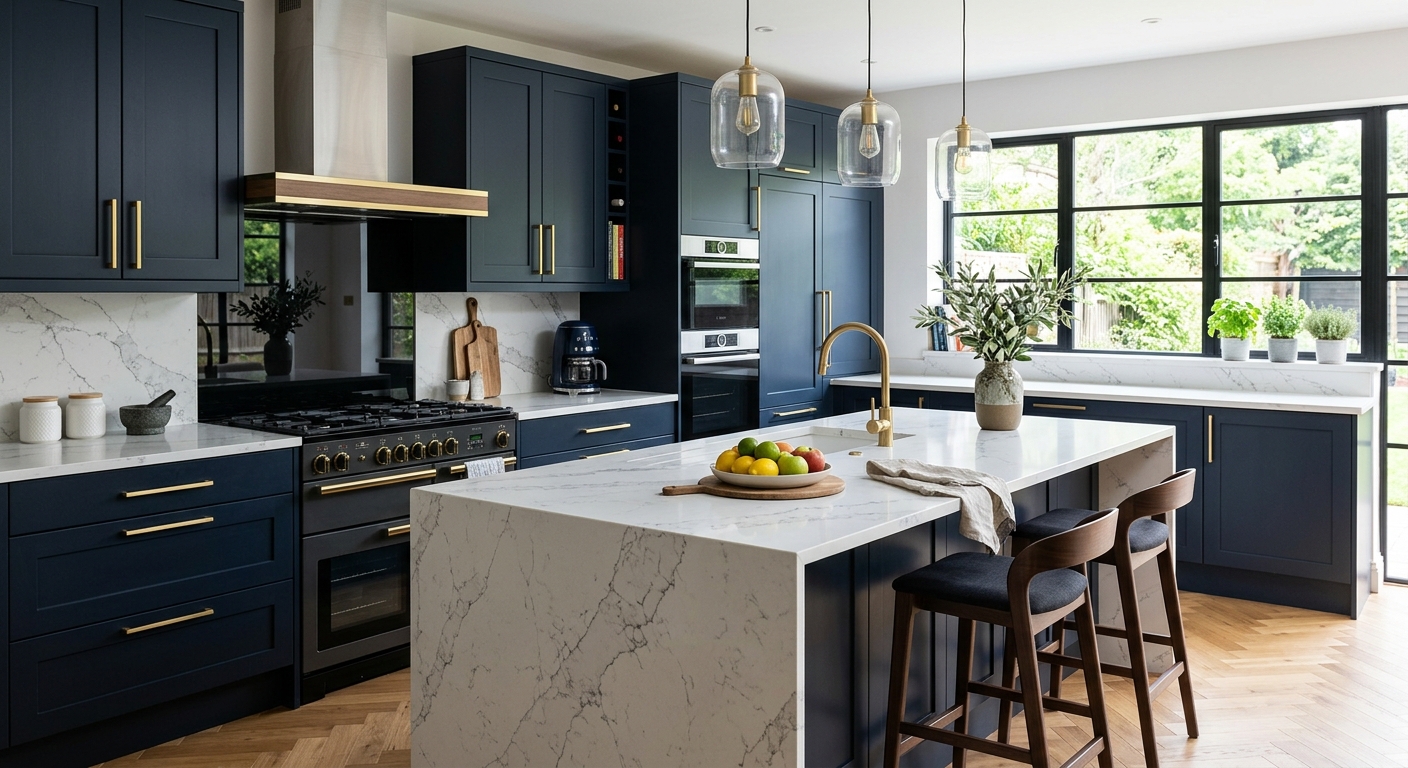
Washington kitchen renovation prices by scope — 2026
In Washington, Pennsylvania, kitchen renovation costs are shaped by both the dynamics of the local housing market and the nature of the homes themselves. With a median household income of $50,548 and a homeownership rate below half (U.S. Census Bureau, ACS 2024), most residents budget carefully, whether they’re updating for long-term use or resale. Local homes are overwhelmingly pre-1980 construction: 89.6% were built before then, and a huge share are tract houses from Washington County’s 1950–1980 boom. These older kitchens are more likely to require modernization—not just cosmetic updates, but often a fuller reworking of walls, plumbing, and electrical systems to suit today’s layouts and lifestyles.
The biggest risk to any kitchen budget is not understanding these levels of scope. Many Washington homeowners plan for cabinet replacement, only to end up gutting walls when they discover electrical or plumbing behind 1970s cabinets isn’t up to code. The chart below shows how quickly the price and timeline can change from simple to complex. Make every scope choice deliberately: pricing for a cosmetic upgrade won’t protect you from the real numbers if the project becomes a full gut renovation.
| Scope |
What's included |
Duration |
Price range |
| Full gut remodel, same layout |
cabinets, counters, appliances, flooring, lighting, fixtures |
6–10 weeks |
$27,000–$109,000 |
| Gut plus layout change |
all of the above plus moved plumbing, electrical, walls |
10–16 weeks |
$59,000–$109,000 |
| Cabinet replacement (stock to semi-custom) |
remove and install cabinets, hardware, patching |
1–3 weeks |
$6,400–$27,000 |
| Cabinet refacing |
new doors and drawer fronts, veneer, hardware |
3–6 days |
$6,400–$18,000 |
| Countertop replacement only |
template, fabricate, install, reconnect sink |
1–3 weeks |
$3,600–$14,500 |
| Kitchen flooring only |
remove existing, install new flooring |
3–6 days |
$4,500–$18,000 |
Estimates for a typical Washington kitchen. Cabinet grade and whether the layout changes move these figures more than square footage.
The real timeline for a Washington kitchen
Washington County kitchens don’t come together any faster than in Pittsburgh’s core neighborhoods—and sometimes a little slower, due to a slightly tighter finish-trade labor market. Most frustration with kitchen remodeling is about timing. The headline number in the contract is only part of the story; what tends to catch people off guard is the sequence and the stretches of waiting in between.
First, design and measure. Early decisions should be made before demolition. If you’re changing cabinets, these must be measured exactly and ordered before anything is torn out because almost all manufacturers are currently running at least a six-week lead time on stock and semi-custom units. In Washington County, allow extra scheduling time for cabinet delivery and finish professionals, as demand is moderate but consistent.
Demolition doesn’t begin until you have firm cabinet delivery dates. Once demo is done, any changes to electrical or plumbing—typical in pre-1980 kitchens—call for rough-in work and an inspection, which in most municipalities uses a third-party agency. Only then do cabinets get installed.
Here’s the step that nearly everyone underestimates: countertops. Countertop templating (making the template for the cut) can’t happen until the cabinets are permanently set. Even with local crews, expect at least a one-week delay between cabinet installation and countertop templating, another 1–3 weeks for fabrication, and only then will installation and finish work—backsplash, flooring, and trim—be completed.
Trying to rush these steps leads to gaps, not speed. The best approach for a Washington homeowner: order everything that’s variable (cabinets especially) before demo, confirm every trade’s slot, and accept that some waiting is built in. Sequencing—not square feet—determines when you'll have your kitchen back.
Choosing cabinetry
Cabinets are where kitchen remodels in Washington split into sharply different projects. The right decision depends on what you have, what you want, and what you’re willing to spend. Here’s the reality:
Refacing is a good option if the cabinet boxes are structurally sound, square, and the kitchen layout works for you. It replaces all visible surfaces: doors, drawer fronts, and exposed frames, applying new veneer to remain portions. It costs less and delivers a crisp new look, but storage and layout don't change. It’s not a solution if your boxes are sagging, if the walls are out of square, or if you want more cabinet space.
Stock cabinets are mass-produced at fixed sizes. They’re cheapest and quickest to source, but most Washington homes—dating from the 1950–1980 tract housing boom—have walls that aren’t perfectly square, heights that don’t precisely fit standard lines, or odd gaps left by decades of modifications. That’s why semi-custom cabinets are so common here; they adjust for real-world dimensions and allow you to get a clean fit and preferred finish, but you’ll pay for it with both dollars and a longer wait. Full custom cabinets solve any layout challenge, but that’s a tier rarely chosen outside luxury homes in this market.
Across all tiers, construction quality matters: plywood boxes will last decades longer than particleboard; dovetail or doweled drawers outperform stapled boxes; soft-close and full-extension hardware are worth every penny for daily use. Frameless cabinets offer more storage in the same footprint but are less forgiving of less-than-perfect walls—again, an issue in older Washington kitchens.
| Option |
Cost |
Best when |
Limitation |
| Painting existing cabinets |
$1,200–$3,500 |
boxes and doors sound, tight budget |
no layout or style change |
| Refacing |
$6,400–$18,000 |
boxes square and layout works |
storage unchanged |
| Stock cabinets |
$6,400–$27,000 |
standard dimensions fit |
filler strips, limited finishes |
| Semi-custom |
$18,000–$27,000 |
non-standard walls or finishes |
6–12 week lead time |
| Full custom |
$18,000–$27,000 |
unusual layout or high-end design |
longest lead, highest cost |
Code requirements for Washington kitchens
In Washington County, not every kitchen update requires permits—but the line is sharper than most homeowners expect. Cosmetic changes like painting, installing new cabinet hardware, refacing existing cabinets, or swapping out a countertop with identical sink and appliance locations typically do not need a permit. However, if your kitchen renovation in the City of Washington involves structural changes, new electrical circuits, or the relocation of plumbing fixtures, a building permit is required. If you’re making changes to walls, electrical service, or plumbing risers, you’ll also need to submit plans for review before work begins.
Electrical inspections aren’t always handled by the municipality. In Washington County’s municipalities, these are commonly performed by third-party agencies such as Middle Department Inspection Agency—an arrangement that surprises many, but is standard here.
For any contract over $500, your contractor must be registered with Pennsylvania’s Home Improvement Contractor (HIC) registry, managed by the Office of Attorney General. You can verify this registration online before signing. Crucially, every employer is required to carry workers’ compensation insurance; you can look this up for yourself before work starts to make sure the job is fully covered.
If you skip permits on required scope, it often comes back at resale: buyers’ inspectors flag unpermitted work, and municipalities can withhold the certificate of occupancy. In pre-1980 homes, where upgrades usually trigger code review, this risk is real and not worth taking.
Where the money actually goes
Most of your Washington kitchen budget—often 30% or more—will disappear into cabinetry, followed by installation labor, then counters, appliances, flooring, and all the visible “extras.” Many homeowners expect appliances to drive the budget, but unless you go ultra-premium, they don’t come close to what cabinets and professional labor cost. Countertops are the other main swing factor, climbing sharply for real stone or quartz. Lighting and new electrical circuits, especially in Washington’s predominantly pre-1980 homes, add up fast if circuits are split or brought to code.
What nearly everyone leaves out of their early plan: money for what’s lurking behind the walls. In an older tract house, unknowns—out-of-plumb framing, original plumbing, odd wiring—are rule, not exception. Plan on at least 10–15% as a contingency. The other hidden line is for soft costs—permits, design, delivery, and hauling off debris. These are real and rarely waived, especially in municipal Washington.
Where does an extra thousand dollars buy the most? Quality cabinet hardware and a single upgraded light fixture outlast a brand-name range. Conversely, putting high-end appliances into a kitchen with box-store cabinets is almost always a bad spend. Anchor your budget to quality cabinets, a durable countertop, and enough labor to do the job right. For a typical full kitchen gut in Washington, the table below breaks down the shares by service cost bands:
| Category |
Share of budget |
Notes |
| Cabinetry |
25–35% |
the largest line and the longest lead time |
| Labour and installation |
20–30% |
rises sharply if the layout changes |
| Countertops |
8–15% |
material choice drives the swing |
| Appliances |
10–20% |
widest range of any category |
| Flooring |
5–10% |
|
| Lighting and electrical |
5–10% |
higher in older homes needing circuits |
| Plumbing and fixtures |
4–8% |
|
| Permits, design, disposal |
3–6% |
usually forgotten in early budgets |
| Contingency |
10–15% |
not optional in a pre-1980 house |
Four kinds of kitchen project, four budgets
In Washington County, “kitchen remodel” covers everything from a quick DIY update to a complete rework involving structure, plumbing, and permits. Here are the four clear tiers you’ll encounter:
1. Cosmetic refresh: paint, lighting, hardware, backsplash. No cabinet or layout changes, no new plumbing or electrical circuits. This is weekend work, not a full remodel, and runs the smallest budget.
2. Pull and replace: new cabinets, counters and appliances, but the sink and stove stay where they are. Electrical and plumbing simply reconnect. This tier keeps things simple and lower cost.
3. Gut, same layout: everything to the studs, new cabinets, counters, lighting, appliances, plumbing and electrical upgraded, but nothing moved—this is what most Washington tract kitchens need due to their age and the wear on utilities.
4. Layout change: moving the sink, range, or walls. This is where costs spike because permits, engineering, and specialty trades come into play. It involves more than just material costs; it needs the right professionals for both planning and execution.
The biggest cost jump is between gutting to upgrade the existing layout and actually moving services or changing the footprint. Moving fixtures or knocking down walls triggers entirely different engineering, plan reviews, and city permitting. Before you call for estimates, define your project tier—a contractor cannot price work they haven’t seen, and “just redo the kitchen” covers a fivefold cost range in Washington.
Practical survival during the work
Being without a kitchen for weeks isn’t just inconvenient—it changes daily life and adds real costs above the job itself. In Washington County, setting up a temporary kitchen space is essential. Most homeowners tuck the fridge into a dining or living space, set up a folding table with a microwave, coffee maker or kettle, and use a bathroom or laundry sink for washing up. It’s paper plates and takeout for longer than you think.
Dust is the enemy, especially in older homes with plaster, tile, and sixty years of kitchen grease behind the walls. Reputable contractors will isolate the workspace with plastic sheeting and zip walls. If you have pets, expect doors to be open more than usual; plan for interruptions and possible escapes. Crews need space for a dumpster and staging of materials—confirm where that will go so your driveway or yard isn’t tied up unexpectedly.
Some families move out during the messiest week if demolition or drywall is extensive, but most tough it out. What catches people off guard is the food budget: eating out for six to eight weeks can outstrip the cost of new flooring. Plan for it. In Washington, this is the line that people forget, and it can easily total $1,200–$2,000 for a typical family.
Frequently asked questions — kitchen renovation in Washington
Should I renovate before selling or let the buyer do it?
The decision depends on the state of your kitchen and the local market. In Washington, most buyers expect a move-in ready home, but not every renovation brings a dollar-for-dollar return. If your kitchen is clean, functional, and not holding back the home's value, it’s often better to keep the price lower and let the next owner remodel to their taste—especially given the county’s dominant pre-1980 tract homes, which may face hidden electrical or plumbing surprises. However, if the layout or finishes are badly outdated—think original laminate counters or failing cabinets—it may be worth making targeted updates. Full gut remodels in Washington cost $27,000–$109,000, and you rarely recoup that on resale unless the rest of the home and market justifies it. If you're selling soon, cosmetic refreshes or simple countertop replacements ($3,600–$14,500) can boost appeal at much lower risk.
What should I expect in a pre-1980 Washington kitchen?
Washington County’s housing stock is almost 90% pre-1980 (U.S. Census Bureau, ACS 2024). That means you’re likely to find tight galley layouts, older plumbing that won’t pass current inspections, mixed metal supply pipes, and original electrical panels with too few circuits for modern appliances. Walls aren’t always plumb or square, complicating cabinet replacement—often pushing owners toward semi-custom solutions ($18,000–$27,000). Lead paint is possible on walls, trim, or cabinets in pre-1978 homes, so EPA Lead RRP rules apply during demo. Plan a generous contingency for unknowns: expect original subfloors, hidden tile, and patchwork wiring in many cases. Prepare for permit and inspection requirements if you’re moving major utilities.
How should renovation payments be scheduled?
In Pennsylvania, for any contract over $500, a written contract is required, and under the Home Improvement Consumer Protection Act, you have a 3 business-day right of cancellation. Standard practice in Washington is an initial deposit of 10–30% upon signing (never pay in full before work starts), with the balance split over milestones: after delivery of cabinets, after rough-in inspection, after countertop installation, and a final payment upon completion. Avoid front-loading payments; reputable contractors can cover materials until the first visible progress. For example, a typical full gut remodel costing $59,000 might require $5,900–$17,700 to start, with the remainder in phased draws. Always tie payments to completed work, not just promises.
What does a quartz countertop cost in Washington?
Quartz is a popular choice for its durability and low maintenance. In Washington, the installed price for quartz countertops runs $3,600–$14,500 depending on the thickness, edge detail, color, and complexity of cutouts. The typical cost for most Washington kitchens hovers around $8,200. Some lower-cost lines are available if you stick with standard slabs and edges, but premium colors or waterfall ends push the total toward the high end. These prices include templating, fabrication, installation, and reconnecting undermount sinks. If your project is part of a larger gut remodel, the per-square-foot cost may be slightly less due to volume, but countertop-only projects are at the higher end of these bands.
Does replacing cabinets require a permit?
In Washington County, you typically don’t need a permit if you’re just swapping cabinets for new ones in the exact same locations and not changing or adding plumbing or electrical. For example, Peters Township often allows like-for-like cabinet door replacement without a permit. However, in the City of Washington, if you move the sink, change the electrical layout, or add circuits for upgraded appliances, a permit is required and a formal plan review may be triggered. Always check with your local municipal office before work starts. If your contractor says not to bother with permits for a full gut job—especially when costs can be as high as $109,000—that’s a red flag.
How much more does moving the sink and range cost?
Shifting the location of a sink or range in Washington isn’t just about moving pipes or wires—it triggers a new set of requirements: building permits, engineering for new venting or structure, and sometimes even plumbing upgrades if old supply lines are discovered. The price jump is significant. While a full kitchen gut remodel with the same layout starts at $27,000, changes that involve moving plumbing and electrical can push the project into the $59,000–$109,000 range, depending on complexity. This extra cost mostly covers labor, materials, engineering, and permitting, so it’s seldom justified for simple convenience. Unless layout improvements are vital, keeping utilities in place is the biggest single way to contain costs.
Should I choose plywood or particleboard cabinet boxes?
In Washington kitchens, especially older homes with occasional moisture issues or less-than-plumb framing, plywood cabinet boxes are the clear winner for durability. They resist warping and water damage far better than particleboard. While particleboard lowers upfront costs—most stock and some semi-custom cabinets use it—you’re more likely to see sagging, swelling, or failure around sinks over time. Expect to pay more for plywood boxes, especially at the semi-custom level ($18,000–$27,000 for a full set); but they’ll outlast cheaper boxes and survive the dings of daily wear in busy family kitchens. For high-traffic, high-humidity parts of Washington County, plywood is always my recommendation.
Should I order cabinets before demolition?
Absolutely. In Washington County, every delay I see in kitchen jobs is tied to waiting for cabinets. Because most local homes were built between 1950 and 1980 and require semi-custom adjustments, cabinet lead times are real: 6–12 weeks isn’t unusual for special orders. Ordering prior to demolition is the only way to guarantee your kitchen isn’t stuck as a jobsite waiting for delivery. Only tear out your existing cabinets once the manufacturer has committed to a delivery date and you’ve confirmed with your installer. For a cabinet replacement job ranging from $6,400–$27,000, time is just as valuable as budget.
What is the cheapest way to update a Washington kitchen?
The lowest-cost updates keep everything in place: repainting existing cabinets, replacing hardware, installing a new backsplash, and swapping out light fixtures—all without moving utilities or opening walls. Painting cabinets in Washington runs $1,200–$3,500 and can completely transform the feel of a dated kitchen without labor or permit costs. For a bit more, consider new laminate counters ($3,600–$14,500), but skip full layout changes, as those shift the budget beyond a simple refresh. Most pre-1980 kitchens benefit hugely from new lighting and a deep clean—sometimes that’s all you need to buy yourself a few more years before considering a major remodel.