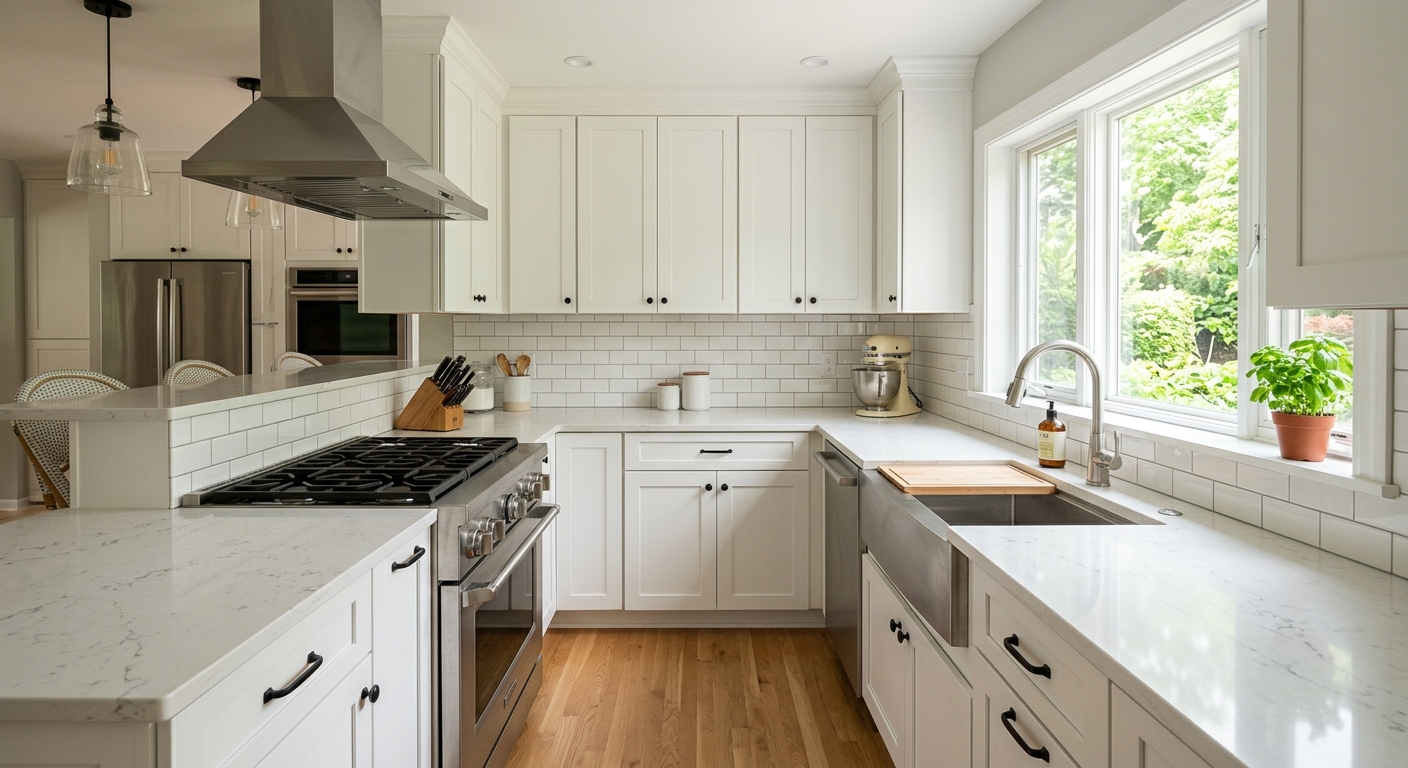
What a kitchen remodel costs in Chester
In Chester, full kitchen renovation costs span a wide range, shaped directly by the area’s modest median income of $39,193 and a comparatively low owner-occupancy rate of 38.0% (U.S. Census Bureau, ACS 2024). Most homeowners here aren’t aiming for an ultra-luxury kitchen—just a practical, updated space that fits the home’s value and real use. Much of Delaware County’s housing stock dates from 1920–1960, yielding many small galley kitchens needing layout reconfiguration. That means many remodels quickly go beyond just new cabinets or floors: moving a wall or shifting the plumbing is common, instantly pushing costs into the next band.
The single biggest reason kitchen remodels in Chester blow the budget is when owners price a “replace in place” scope but then decide mid-project to change the layout, which always adds at least another week and can double labor and permit costs. Careful planning—and an honest assessment of how much change the kitchen really needs—matter more than the square footage in controlling cost.
| Scope |
What's included |
Duration |
Price range |
| Full gut remodel, same layout |
cabinets, counters, appliances, flooring, lighting, fixtures |
6–10 weeks |
$29,000–$116,000 |
| Gut plus layout change |
all of the above plus moved plumbing, electrical, walls |
10–16 weeks |
$62,500–$116,000 |
| Cabinet replacement (stock to semi-custom) |
remove and install cabinets, hardware, patching |
1–3 weeks |
$6,800–$29,000 |
| Cabinet refacing |
new doors and drawer fronts, veneer, hardware |
3–6 days |
$6,800–$19,500 |
| Countertop replacement only |
template, fabricate, install, reconnect sink |
1–3 weeks |
$3,900–$15,500 |
| Kitchen flooring only |
remove existing, install new flooring |
3–6 days |
$4,800–$19,500 |
Estimates for a typical Chester kitchen. Cabinet grade and whether the layout changes move these figures more than square footage.
Living through a kitchen renovation
Surviving a kitchen remodel in Chester means living without your main work space for anywhere from a week to four months, depending on the project’s scope. Most families set up a temporary kitchen spot—a folding table for a microwave, coffee maker, and toaster, with the fridge moved into the living room or dining area. The laundry or bathroom sink stands in for dishwashing, and paper plates become your best friend. Food spending always rises: even a modest eight-week remodel means more takeout and prepared foods, which often ends up costing more than new flooring, so plan for that as a real project expense.
Contractors will seal off the work zone with zip walls and thick sheeting, but dust always finds a way through. Good dust control is not just about comfort: in older Delaware County homes, disturbed dust can carry lead from pre-1978 paint layers, making barrier quality more than a minor point.
Expect a dumpster somewhere on your property for demolition debris, and plan a staging area for cabinets and appliances—usually the garage, driveway, or a corner of the yard. Pets pose a risk with open doors and foot traffic; if yours are escape-prone or sensitive to noise, boarding them for demolition week is worth considering.
If you’re especially sensitive to noise or disruption—or if your renovation involves moving walls or extensive rewiring—moving out during the messiest week can actually cost less than dealing with the fallout. In Chester, the extra cost of eating out for eight weeks is easily $2,000–$4,000, which often exceeds what you’d spend on new kitchen flooring.
Quartz, granite, laminate or butcher block
Your countertop choice in Chester kitchens comes down to how you use your space. Quartz (engineered stone) is non-porous, resists stains, and never needs sealing, but it can discolor or crack under high heat, so hot pans should never go directly on it. Granite is durable and handles heat well, but it needs periodic sealing to avoid stains and dark rings. Laminate, such as modern Formica, is far better than many remember: it resists stains, cleans easily, and is a smart choice for moderate-budget or rental kitchens—if it’s done right, it doesn’t look cheap. Laminate’s only real downsides are less heat tolerance and somewhat visible seams. Butcher block is warm to the touch and looks great, but it demands frequent oiling and shows every cut or spill. Left untreated, it stains and soaks up water quickly.
Solid surface (like Corian) sits in the middle—it’s easily cleaned and can be re-sanded to remove scratches or burns, making it the only truly “repairable” countertop in routine use. Whatever material you pick, price is driven by fabrication details: fancy edge profiles, extra sink or cooktop cutouts, and the location of seams. Templates—a visit where a tech traces your actual layout—make installation much more precise than just measuring with a tape.
There’s no shame in laminate for a modest Chester kitchen or rental; it’s practical and pairs well with just about any cabinet. Sometimes, spending more on new LED lighting or functional cabinets rather than a premium stone is a better use of the budget.
What's behind the walls in a Chester kitchen
Because 85.6% of Chester’s homes were built before 1980, and most kitchen layouts date from the 1920–1960 wave, surprises lurk behind every plaster wall. The most common costs come from out-of-plumb walls and out-of-level floors—installing new cabinets often means shimming every run to get doors to sit square, adding labor and sometimes requiring custom fillers. Wiring in many kitchens is original: you may find ungrounded outlets or undersized wires, which require bringing the electrical system up to modern code for $3,500–$8,000 if fully replaced from panel to outlets.
On the plumbing side, galvanized supply lines or cast iron drains are common. Replacing these can run $1,800–$5,500 depending on the length and what’s accessible. Exterior walls are often uninsulated, especially in galley kitchens, and adding insulation during a remodel is both wise and cost-effective (typically $600–$1,200 just for the wall under reno). Many homes have evidence of previous unpermitted work—random wiring, odd plumbing runs, or patch jobs—which all slow progress.
For homes built before 1978, the federal EPA Lead RRP Rule applies, so any disturbance of painted surfaces (walls, trim, window casings, even floors) requires lead-safe practices and proper disposal. Older vinyl or linoleum may also conceal asbestos, especially in 1950s–1960s builds. Always have suspect materials tested before disturbing them; abatement or proper handling is a safety requirement, not a “nice-to-have.”
Where the money actually goes
In Chester, cabinetry is the single largest line item in most kitchen remodels—typically taking 25–35% of your budget, whether you go stock, semi-custom, or all the way to custom. Labor and installation come next (20–30%), especially if your project involves moving walls or rerouting plumbing. Counters are a smaller—but still significant—piece, with materials (from basic laminate to high-end stone) swinging this line between 8–15%. Appliances can gobble much of the remainder (10–20%), especially if multiple units are upgraded or brands are specified.
Lighting, flooring, plumbing, and fixtures take smaller shares but add up fast, particularly when older Chester homes need additional electrical circuits or subfloor repair. Two categories are consistently underestimated: permits, design, disposal (3–6%), and contingency (10–15%). You need both, especially for pre-1980 homes where surprises are the norm. Skimping here risks a half-finished kitchen or delays.
Where does an extra thousand dollars go furthest? Functional upgrades—like extra outlets, better lighting, or drawers over cabinets—beat any cosmetic splurge. Where does it have the least effect? High-end appliances in a kitchen still using stock, entry-tier cabinets rarely pay off in function or resale. For a typical Chester full gut remodel at $62,500, every percentage point translates to real dollars.
| Category |
Share of budget |
Notes |
| Cabinetry |
25–35% |
the largest line and the longest lead time |
| Labour and installation |
20–30% |
rises sharply if the layout changes |
| Countertops |
8–15% |
material choice drives the swing |
| Appliances |
10–20% |
widest range of any category |
| Flooring |
5–10% |
|
| Lighting and electrical |
5–10% |
higher in older homes needing circuits |
| Plumbing and fixtures |
4–8% |
|
| Permits, design, disposal |
3–6% |
usually forgotten in early budgets |
| Contingency |
10–15% |
not optional in a pre-1980 house |
Permits and inspections for a Chester kitchen
In Chester and across Delaware County, most kitchen renovations that stop at new paint, refacing cabinets, switching hardware, or a simple countertop swap do not require a building permit. However, once your project includes new or relocated electrical circuits, significant plumbing changes, or moving/removing walls, you’ll need to get a permit—and in most townships, this triggers a plan review by the local building department.
Electrical inspections in many Delaware County municipalities are typically performed by third-party agencies approved by the township, rather than by the township itself. Homeowners are often surprised by this, but it means inspections are arranged directly with these private code inspectors—so you’ll want to check your township’s list and build their scheduling into your timeline.
Any contractor working on your kitchen must have a current Home Improvement Contractor (HIC) registration from the Pennsylvania Office of Attorney General for contracts above $500. You can verify this at hic.attorneygeneral.gov. All employers must also carry workers’ compensation; that’s verifiable via the state’s WCAIS system (wcais.pa.gov). Written contracts are mandatory, and you are always entitled to a three business-day right of cancellation. Never sign a blank contract or agree to waive your insurance deductible, as that’s prohibited by Pennsylvania law.
Doing unpermitted work in Chester can haunt you at resale. Building departments and buyers’ attorneys often dig into permit records, and missing paperwork for electrical or structural work can delay or derail closings. Always check with your township before work begins.
Cabinets: reface, stock, semi-custom or custom
Your choice of cabinets drives your Chester kitchen project’s look and cost more than any other decision. Refacing is the most budget-friendly option: your contractor keeps the existing cabinet boxes, resurfaces them with new veneer, and installs new doors, drawer fronts, and hardware. This is only a smart call if the boxes are level, solid, and fit your storage needs—it’s not a fix for poor layouts or thin particleboard that's seen better days.
Stock cabinets are the most affordable new-cabinet solution, but they come only in a set range of sizes. In Chester’s older homes—where walls are rarely square and galley layouts dominate—stock cabinets often leave awkward gaps filled with spacers or “filler strips.” Semi-custom cabinets cost more but allow your installer to adjust dimensions and finishes to fit, often the right choice given Delaware County’s non-standard wall dimensions from the 1920–1960 building wave. Full custom cabinets will fit any space and style, but the price tag and lead time climb accordingly.
Regardless of price tier, check construction quality: plywood boxes last longer and resist moisture better than particleboard, and dovetailed drawers fare far better than stapled or glued joints. Hardware upgrades—like full-extension, soft-close slides—give real day-to-day value. Frameless (European) cabinets offer slightly more storage and a cleaner look, while face-frame types match most older homes’ style. In Chester, semi-custom is often the happy middle ground—usable in tight or odd-shaped kitchens without full custom cost.
| Option |
Cost |
Best when |
Limitation |
| Painting existing cabinets |
$1,200–$3,500 |
boxes and doors sound, tight budget |
no layout or style change |
| Refacing |
$6,800–$19,500 |
boxes square and layout works |
storage unchanged |
| Stock cabinets |
$6,800–$29,000 |
standard dimensions fit |
filler strips, limited finishes |
| Semi-custom |
$19,500–$29,000 |
non-standard walls or finishes |
6–12 week lead time |
| Full custom |
$19,500–$29,000 |
unusual layout or high-end design |
longest lead, highest cost |
Frequently asked questions — kitchen renovation in Chester
What does a full gut kitchen remodel cost in Chester?
In Chester, a full gut kitchen remodel—which means stripping everything to the studs and replacing cabinets, counters, appliances, flooring, and lighting—ranges from $29,000–$116,000. Most typical projects land around $62,500. Budgets swing based on finish level, moving plumbing or walls, and the age of your house, since older homes almost always bring electrical or plumbing surprises. With a modest local median income and lower owner-occupancy rate (U.S. Census Bureau, ACS 2024), most owners keep changes practical, focusing on function and durability. If a contractor quotes you well below that band, read the fine print—what’s left out will end up in your change order costs.
What is an allowance in a renovation quote?
An allowance in a Chester kitchen quote is a placeholder budget for a material or fixture yet to be selected, like “appliance allowance” or “tile allowance.” For instance, your contract might list a countertop allowance of $4,000. If you choose a slab costing more, you pay the difference; if less, you get a credit. Allowances mean you don’t have to finalize every choice before signing but do require close attention to keep total costs predictable. In older Delaware County homes, allowances for electrical and plumbing are smart, since unforeseen code upgrades are a real possibility.
What flooring works best in a kitchen?
Kitchen flooring in Chester needs to handle both moisture and heavy foot traffic, especially in pre-1980 homes where floors may be uneven. Sheet vinyl and luxury vinyl plank (LVP) give a waterproof, low-maintenance finish for the lowest end of the budget, while porcelain tile offers superb durability and can handle an active family or rental. If your kitchen is part of a larger open plan, hardwood remains popular but can be riskier where water spills are common. Flooring-only projects typically cost $4,800–$19,500 depending on material and prep needed. In older homes, be ready for underlayment or subfloor repairs if the base isn’t level.
Do older Chester homes need electrical upgrades for a kitchen?
Yes—a majority of Chester’s kitchens were built decades before today’s appliance and code standards. Most have original wiring that lacks grounding or sufficient capacity for modern refrigerators, dishwashers, or microwaves. Remodeling a kitchen built before 1980 almost always triggers at least some electrical upgrade. Full rewiring can cost $3,500–$8,000, but even minor work—like adding dedicated circuits for appliances—makes a kitchen safer and avoids future inspection issues. Plan for this early, since work behind the walls is cheapest before new cabinets go in.
How much do new kitchen cabinets cost in Chester?
New kitchen cabinets in Chester, using stock or semi-custom types, typically run $6,800–$29,000 installed. Stock cabinets work best in kitchens with standard dimensions, but most older homes, with non-square walls and galley layouts from the 1920–1960 construction surge, lean toward semi-custom—often in the $19,500–$29,000 bracket—just to fit the space. Custom cabinetry climbs higher, with longer lead times. Quality (plywood boxes, full-extension drawers) makes more daily difference than decorative extras do.
How far ahead should I book a contractor in Chester?
For a full kitchen remodel in Chester, it is wise to contact your contractor at least 3–5 months before your ideal start date. Contractors in Delaware County often have backlogs, especially during spring and fall. The high demand is driven by both the density of homes and the wave of upgrades hitting kitchens built in earlier eras. Some projects requiring semi-custom or custom cabinets (in the $19,500–$29,000 band) take even longer due to manufacturing lead times. Early planning also leaves you time for plan review and material decisions.
Can I over-improve for my Chester neighbourhood?
Absolutely—when kitchen costs more than $62,500, it can quickly outpace the resale value increase in much of Chester, especially in areas with lower median income and owner-occupancy rates. Investing in high-end appliances or finishes in a neighborhood where most homes stay basic can leave you with a return that’s less than your spend. Focus on durable, attractive, functional upgrades—don’t chase luxury brands unless you’re planning to stay put for a decade or more. Good lighting, convenient storage, and quality cabinets pay back better than designer tile or professional-grade appliances in most Chester homes.
Should I reface or replace my kitchen cabinets?
Refacing is a strong choice in Chester if your cabinet boxes are still sturdy, square, and laid out well for your family’s needs. For $6,800–$19,500, you get new doors, drawer fronts, and surface veneer—cosmetic changes only. You can’t add storage or reconfigure the layout. If your boxes are particleboard and showing rot, or if you want to change from a galley to an open kitchen (which is common in the area’s older homes), replacement makes more sense. New stock or semi-custom cabinets run $6,800–$29,000 installed but offer the structural and design flexibility many Chester kitchens require.
Does replacing cabinets require a permit?
In most Delaware County municipalities, including Chester, simply replacing cabinets with no electrical, plumbing, or wall changes does not trigger a permit requirement. However, moving appliances, adding new circuits, or opening walls for any reason will almost always require permits and plan review by your township’s building office. Projects involving just cabinet refacing or paint are considered cosmetic and do not require permits, but always check with your local township office before starting to avoid resale headaches or inspection delays later. For most kitchen remodels that upgrade beyond surface changes, permit costs are typically in the $900–$2,500 range.