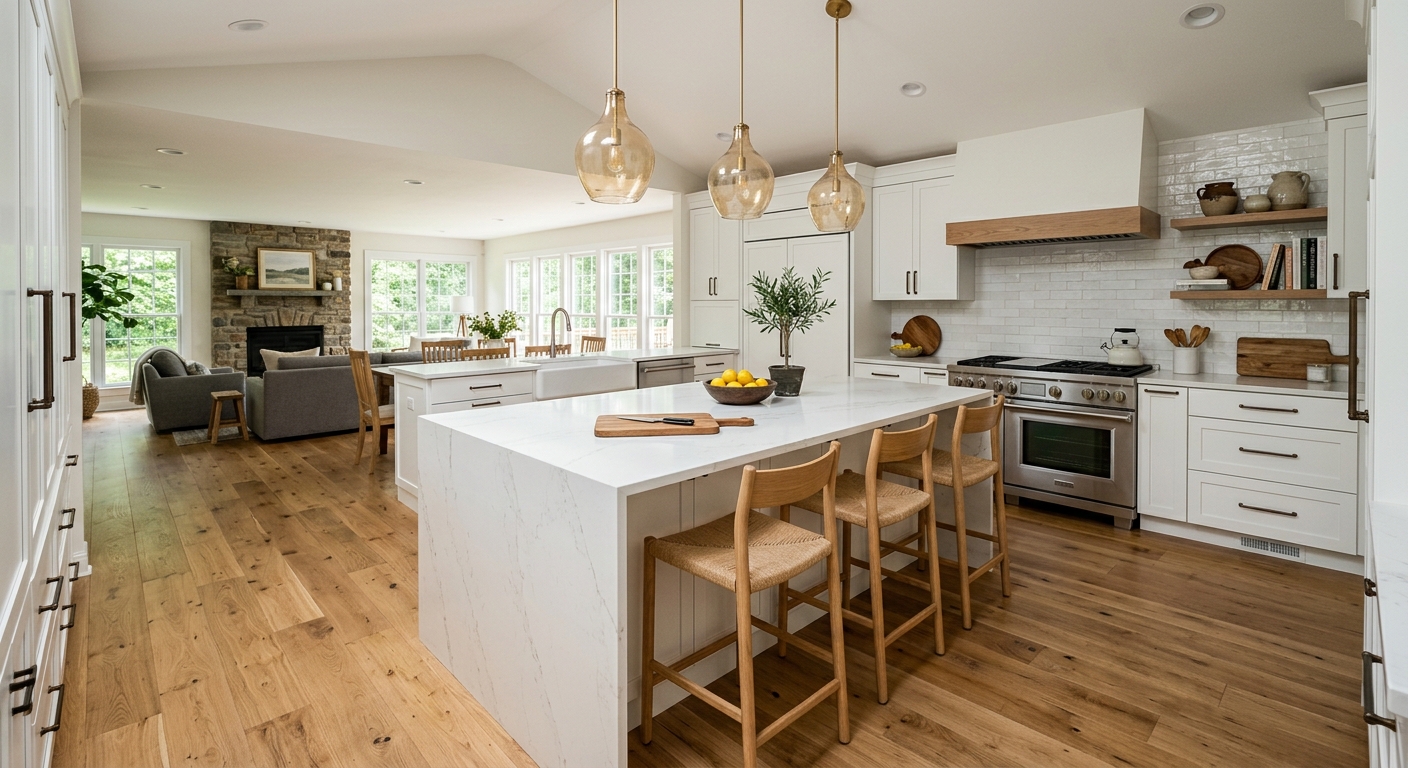
Kitchen renovation costs in Bellevue — 2026
Bellevue’s kitchen renovation costs reflect both its older housing and the realities of homeownership here. With 86.4% of the housing stock built before 1980 and a homeownership rate of 41.3% (U.S. Census Bureau, ACS 2024), most projects are driven by owners who plan to stay put, not landlords looking to minimize spend. Pre-1940 homes, common throughout Allegheny County, often mean small, compartmentalized kitchens that benefit from gut renovations, wall removals, and new layouts — not just surface upgrades.
Many kitchen budgets are blown by planning around the costs for a “pull and replace” job, then falling in love with open-plan designs that require extensive structural, plumbing, and electrical changes. The cost jump between updating finishes and moving fixtures or walls is substantial, and surprises are expensive once the work is underway. Understanding where your project falls on this spectrum is the key decision before you gather quotes.
| Scope |
What's included |
Duration |
Price range |
| Full gut remodel, same layout |
cabinets, counters, appliances, flooring, lighting, fixtures |
6–10 weeks |
$28,000–$113,000 |
| Gut plus layout change |
all of the above plus moved plumbing, electrical, walls |
10–16 weeks |
$61,000–$113,000 |
| Cabinet replacement (stock to semi-custom) |
remove and install cabinets, hardware, patching |
1–3 weeks |
$6,600–$28,000 |
| Cabinet refacing |
new doors and drawer fronts, veneer, hardware |
3–6 days |
$6,600–$19,000 |
| Countertop replacement only |
template, fabricate, install, reconnect sink |
1–3 weeks |
$3,800–$15,000 |
| Kitchen flooring only |
remove existing, install new flooring |
3–6 days |
$4,700–$19,000 |
Estimates for a typical Bellevue kitchen. Cabinet grade and whether the layout changes move these figures more than square footage.
Who should run your Bellevue renovation
How you structure your kitchen renovation matters more to cost and stress than any single material choice. Bellevue homeowners generally choose between three models: design-build firms, general contractors, or managing trades themselves.
A design-build kitchen firm is the most hands-off approach. They handle design, cabinets, trades, and installation under one contract. This costs more, but reduces homeowner effort and leaves little room for finger-pointing — ideal if your time is valuable or you aim for a high-end, unified project. A general contractor model is mid-way: you or your designer decide the layout and finishes, then a contractor coordinates the plumbers, electricians, and carpenters. This typically lands in the middle price-wise and demands more decisions from you, but also gives more flexibility.
Owner-managed means you hire and schedule each trade. This is the lowest cost — on paper. But in the Bellevue and broader Allegheny County market, with finish-trade labor in high demand due to steady urban remodeling, coordinating reliable contractors isn’t easy. Missed handoffs and delays can drag projects out for months. If you have a full-time job or your project involves moving walls or changing services (which triggers permits and often plan review), managing yourself will almost certainly cost more in headaches and delays than it saves in cash. For most, hiring either a general contractor or design-build firm is the practical, cost-predictable route, especially on anything much bigger than a cosmetic refresh.
Defining your scope before you get quotes
“Kitchen remodel” means everything from swapping a faucet to gutting your space to studs, and the difference is fivefold or more in Bellevue. Sorting out your scope before calling anyone prevents sticker shock and wasted time. Four clear tiers shape almost every project here:
- Cosmetic refresh: Painting walls and cabinets, swapping hardware, updating lighting, and maybe a new backsplash. No cabinet swaps or layout changes. Fastest, cheapest, and doesn’t trigger permits.
- Pull and replace: New cabinets, counters, and appliances in the same footprint. Some patching and updating, but no major plumbing or electrical move. This is what many owners hope for, especially in post-1980 homes where layouts already work.
- Gut, same layout: Down to the studs. All services (wiring, plumbing) replaced or updated, but stay in their original places. This is essential in many older Bellevue homes, where worn finishes hide wiring or pipes from the 1920s–1950s. The room looks and works new, but the kitchen is still in the same spot.
- Layout change: Walls move, or the sink, range, or major fixtures shift location. This triggers permits,:
engineering, sometimes plan review — and multiplies costs. Open-plan dreams essentially start here.
The cost cliff between gutting (tier three) and layout changes (tier four) is steep. Moving a sink or stove means relocating pipes and wires, opening walls, and typically involving structural work and plans. Permits in Bellevue and most of Allegheny County are triggered at this point, which brings in both added expense and scrutiny at resale.
Decide your tier before seeking quotes. No contractor can give you a meaningful number until you know whether you’re keeping the layout or chasing that open plan kitchen.
The biggest line item in your Bellevue kitchen
Your decision on cabinets sets the tone — and budget — for your entire Bellevue kitchen renovation. There are four main options:
- Refacing: Keeps existing cabinet boxes and replaces just the doors, drawer fronts, and veneer. This is cost-effective and gives great visual change, but only works if your boxes are solid, square, and the current layout serves your storage needs. Refacing doesn’t fix bad storage or add space. For sturdy 1980s or newer cabinets in a workable footprint, it’s an excellent value. For many Bellevue kitchens with pre-1940 layouts or uneven plaster walls, you’ll often run into limits quickly.
- Stock cabinets: Fixed sizes, lowest cost. Good for newer houses or standard-sized rooms, but expect visible filler strips and fewer finish choices. Fastest lead time and easy replacement if something arrives damaged.
- Semi-custom: Size tweaks and a broader palette of finishes at a notable price bump. For older Bellevue homes with walls that aren’t square, odd dimensions, or the need for clever storage, semi-custom is almost always worth the difference. Even if you start out planning stock, you may end up here once measurements come in.
- Custom: Built for your room, any layout, any finish. Substantial lead times, highest cost. Most practical in historic homes, rooms with complex dimensions, or high-end projects expecting flawless fit and matching details.
Regardless of type, look for plywood (not particleboard) boxes, dovetail (not stapled) drawers, full-extension, soft-close slides, and check whether you want frameless (more storage, modern lines) or face-frame (classic look) construction.
| Option |
Cost |
Best when |
Limitation |
| Painting existing cabinets |
$1,200–$3,500 |
boxes and doors sound, tight budget |
no layout or style change |
| Refacing |
$6,600–$19,000 |
boxes square and layout works |
storage unchanged |
| Stock cabinets |
$6,600–$28,000 |
standard dimensions fit |
filler strips, limited finishes |
| Semi-custom |
$19,000–$28,000 |
non-standard walls or finishes |
6–12 week lead time |
| Full custom |
$19,000–$28,000 |
unusual layout or high-end design |
longest lead, highest cost |
Code requirements for Bellevue kitchens
In Bellevue, as in much of Allegheny County, painting cabinets, changing hardware, refacing, or even swapping out a countertop in place generally don’t require permits. Permits are typically triggered when kitchen renovations involve new or relocated plumbing, electrical circuits, or any structural changes—common for larger Bellevue projects, especially in older homes where owners want to open up closed-off spaces. If your remodel moves appliances, sinks, or walls, expect not just permits but also plan review by the local code authority before work begins.
Electrical inspections within Pittsburgh are performed by the City of Pittsburgh permitting authority; surrounding boroughs, including Bellevue, may use approved third-party inspection agencies. This dual system routinely surprises homeowners and adds a layer of scheduling and paperwork when coordinating trades.
Any contract over $500 must be executed by a contractor registered with the Pennsylvania Office of Attorney General under the Home Improvement Contractor (HIC) registry. You can check their status at hic.attorneygeneral.gov. If your contractor employs workers, they must also carry workers’ compensation insurance—verify through the WCAIS at wcais.pa.gov.
Unpermitted work is a resale risk. Even if it’s well built, future home inspectors or code officers can flag unapproved changes, causing costly delays or retroactive permit headaches when it’s time to sell. Always clarify scope and permitting obligations up front—it protects your investment and resale.
Renovating to live in versus renovating to sell
It matters whether you’re updating your Bellevue kitchen for yourself or for future buyers. Renovating to live in means tailoring the space for how you cook, store, and gather, choosing materials you personally enjoy, and possibly exceeding what the market would otherwise justify. If the plan is to stay for years, build your wish list—there’s real value in having the kitchen you want for daily life.
Renovating to sell, however, is a different exercise. Buyers in Bellevue respond most to neutral finishes, solid quality, and fresh but not flashy updates. Spending at the higher end of the local range—say, more than $61,000 for a gut remodel—rarely pays back dollar-for-dollar, especially since Bellevue’s median household income is $60,778 (U.S. Census Bureau, ACS 2024). There’s a clear ceiling to what remodel costs you can reasonably recoup when compared to resale values in the neighborhood.
Most mid-range updates do help a house sell faster and nearer the asking price, but do not confuse “helps sell” with “pays back.” If selling, restrain your budget and choose flexible, universally liked designs—skip custom layouts and specialty appliances. Save luxury items for projects meant for living in, where enjoyment outweighs investment returns.
Why the electrical line grew
Electrical upgrades are the top source of unplanned costs in older Bellevue kitchens. Current code requires several things that weren’t present even in houses from the 1970s: two or more dedicated 20-amp small-appliance circuits, GFCI outlets at every countertop, outlets spaced every four feet, separate dedicated lines for the dishwasher, microwave, disposal, and at least a 240-volt circuit for an electric range.
In Bellevue’s pre-1940 and pre-1980 housing—over 86% of homes (U.S. Census Bureau, ACS 2024)—it’s not unusual to find a single, ungrounded branch circuit serving the entire kitchen, knob-and-tube or cloth-wrapped wiring, outdated fuse boxes, or sometimes aluminum wiring in later years. Once the walls open, inspectors expect the new work to comply fully with current code, not just patch the old. This is not negotiable and adds weeks and thousands to budgets that started as “just new cabinets and counters.”
Upgrading kitchen electrical to present standards in Bellevue typically ranges from $4,000–$15,000, depending on the service panel, wiring access, and scope. It’s rarely optional when gutting or changing the layout in an older home, so plan for it on the front end—surprises cost more in the middle of a project.
Frequently asked questions — kitchen renovation in Bellevue
Why is there a gap after cabinets are installed?
The gap between new cabinets and uneven walls is common in Bellevue’s pre-1980 homes, where plaster or old framing is rarely square. Most installers leave a small gap at the back or sides, then cover it with trim or caulk for a clean look. This isn’t a sign of poor workmanship, but a reality of working in houses with non-standard dimensions—a feature of most older Bellevue properties. If you opt for stock cabinets (costing $6,600–$28,000), expect more visible filler pieces. Custom or semi-custom cabinets can minimize these gaps, but at a higher price and with longer lead times.
Do I need to change my kitchen layout?
Not always. In Bellevue, especially with pre-1940 layouts, small galley kitchens sometimes benefit from opening a wall or reworking the footprint to improve flow and storage. But relocating walls or moving plumbing or electrical almost always lands you in higher price territory, where a full gut and layout change can reach $61,000–$113,000. If your current layout works and you can update finishes, appliances, and storage within it, you’ll save tens of thousands. A good contractor can help you weigh these choices before you commit.
What is a realistic contingency for a Bellevue kitchen?
For Bellevue’s older homes, a 15–20% contingency is smart, especially for gut renovations. Issues like outdated wiring, hidden water damage, or unexpected framing problems are much more likely in the pre-1980 stock typical here. Even on a moderate budget—say, $28,000–$61,000—set aside extra to avoid halts when surprises are found. For purely cosmetic or pull-and-replace tiers, 10% may be enough. Skip this advice at your own risk; almost every large project in Bellevue unveils at least one hidden problem in the walls or floor.
What is an allowance in a renovation quote?
An allowance lets you budget a set amount for things not selected before work starts, like countertops or tile. For example, your contractor may build in a $8,500 countertop allowance and credit or bill for the difference after your final pick. Allowances help get projects moving but can lead to surprises if your actual selections go well over these numbers. In Bellevue, it’s worth pushing for real product picks—or at least high-clarity allowances—before demolition to avoid disputes mid-project.
Does replacing cabinets require a permit?
In most Bellevue and Allegheny County boroughs, simply swapping out cabinets—no changes to walls, plumbing, or electrical—does not trigger a building permit. Cabinet replacement jobs (in the $6,600–$28,000 range) are often completed without municipal oversight. But if you plan to change the kitchen’s footprint, move any plumbing, or touch wiring, you’re likely headed for permit territory and possibly plan review. Always confirm the latest with your local code office before work begins.
Does a kitchen renovation increase home value in Bellevue?
A good kitchen project makes your Bellevue home more attractive to buyers, but rarely pays back every dollar spent, especially on upscale or major layout changes. The best returns come from mid-range projects ($28,000–$61,000) that avoid over-improving beyond the neighborhood benchmark—the local median income here is $60,778 (U.S. Census Bureau, ACS 2024), which effectively sets a ceiling on what buyers will pay. High-end additions rarely add their full cost to the sale price. If resale is your priority, stick to timeless finishes and moderate upgrades.
Should I choose plywood or particleboard cabinet boxes?
For Bellevue’s sometimes damp, uneven old kitchens, plywood boxes are the safer choice. They resist moisture better and hold up to decades of use—important when many homes have sink or plumbing issues dating back years. Particleboard can work for cabinets on a budget, but is more vulnerable if there’s a small leak. Semi-custom or custom cabinets (ranging $19,000–$28,000) almost always use plywood; stock lines may mix both materials. Weigh your current conditions and plan to stay before making the call.
What does a quartz countertop cost in Bellevue?
Quartz countertop projects in Bellevue typically run $3,800–$15,000, with most kitchens landing around $8,500. Your final price depends on slab selection, edge details, whether your new counters require complex cutouts, and—critically—the size and layout of your kitchen. Older Bellevue homes with odd shapes or added islands will see costs on the higher end. Always ask if the quote includes templating, fabrication, installation, and reconnecting the sink and dishwasher.
What should I expect in a pre-1980 Bellevue kitchen?
Be ready for surprises once you open up any part of a pre-1980 Bellevue kitchen—which is most of the housing stock here. Common issues include outdated wiring, uneven floors, old cast iron or galvanized plumbing, and sometimes even knob-and-tube or cloth wiring. It’s also typical to discover past DIY fixes done without permits. These surprises add time and cost, so build in a 15–20% contingency on any full remodel (budgeting for $28,000–$113,000). Get a reputable contractor who inspects thoroughly, and expect to address at least electrical upgrades to get your finished kitchen signed off at resale.